
Nigeria News
Appeal Court nullifies Emefiele’s asset forfeiture, orders fresh trial

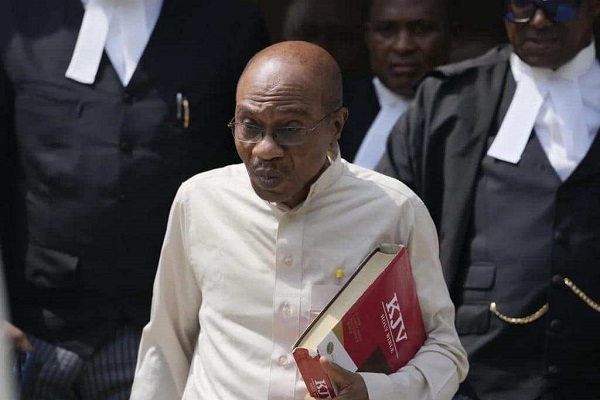
The Court of Appeal in Lagos has overturned the final forfeiture order previously issued against the assets of former Central Bank of Nigeria (CBN) Governor, Godwin Emefiele, and directed a retrial at the Federal High Court.
In a split decision (2-1) delivered on April 9, 2025, and reported by The Punch on Sunday, the appellate court set aside the November 1, 2024 ruling of the Federal High Court in Lagos, which had granted the Economic and Financial Crimes Commission (EFCC) the final forfeiture of Emefiele’s properties.
The controversial assets included luxury properties in Lagos and Delta State, as well as $2,045,000 in cash and share certificates in Queensdorf Global Fund Limited. These assets were alleged by the EFCC to have been acquired through proceeds of unlawful activities.
Emefiele, who was recently arraigned before an FCT High Court over the unlawful acquisition of a 753-unit housing estate in Abuja, challenged the forfeiture at the appellate court through his lead counsel, Olalekan Ojo (SAN).
In his appeal (CA/LAG/CV/1051/24), Emefiele raised five critical issues, including whether the trial judge failed to fairly evaluate the evidence and whether the court had jurisdiction to entertain EFCC’s motion under the Advance Fee Fraud Act.
The EFCC, represented by Rotimi Oyedepo (SAN), countered that Emefiele failed to provide evidence of legitimate income used to acquire the properties. Oyedepo noted that none of the assets was acquired in Emefiele’s name, but through companies where he was neither a shareholder nor director.
He further stated that the companies linked to the properties did not challenge the forfeiture and accused Emefiele of failing to declare the assets to the Code of Conduct Bureau.
However, Justice Abdulazeez Anka, in his lead judgment, held that the earnings presented by Emefiele—ranging from his severance package at Zenith Bank to his 10-year salary as CBN Governor—were sufficient to afford the properties.
Justice Anka concluded that the case was riddled with conflicting evidence and required oral and documentary hearings for clarity.
“The initial affidavit-based hearing must now be replaced by oral testimony where witnesses can be cross-examined. The parties must be given the opportunity to present further evidence,” he said.
Accordingly, the appellate court set aside the final forfeiture and remitted the case back to the Federal High Court for a retrial before another judge, excluding Hon. Justice D.I. Dipeolu.
Justice Anka, however, upheld the forfeiture of the $2,045,000, noting that Emefiele did not contest that particular asset.
Justice Mohammed Mustapha concurred, emphasizing that a person could acquire property in trust for another and that Emefiele’s declared income was sufficient to justify ownership. He also faulted the EFCC’s reliance on asset declaration forms from 2014 and 2019 to question properties acquired between 2020 and 2023.
“It is unreasonable to expect a 2014 declaration to cover assets acquired years later,” Mustapha ruled.
He added that common legal sense dictates the criminal case against Emefiele should be concluded before any civil forfeiture matter proceeds.
Justice Mustapha also supported a partial win for Emefiele, affirming the return of the case to the Federal High Court for retrial before a different judge.










The Idoma woman who drives trains and dreams: Meet Isabella Adams

Tension mount in Benue community as influx of armed herders sparks fear

BREAKING: Pilots survive as NAF Alpha Jet crashes in Kainji

WATCH: Another viral video of Zimbabwe teacher, 16-year-old student leaks on Twitter, Telegram

Watch fresh leaked viral video of Zimbabwe teen, mathematics teacher online

Another viral leaked video of Zimbabwe teacher, 16-year-old student surfaces online

Fresh leaked viral video of Zimbabwe teen, mathematics teacher breaks internet

Troops rescue 14 kidnap victims in Orokam forest operation
Fresh update emerges as Zimbabwe teacher arrested over viral video with teen student

Benue Links denies reducing transport fare

Nigerian Newspaper headlines for today, Saturday, 6th December, 2025
