
Benue news
Battle for Benue: How Akume–Alia feud is tearing the Food Basket apart

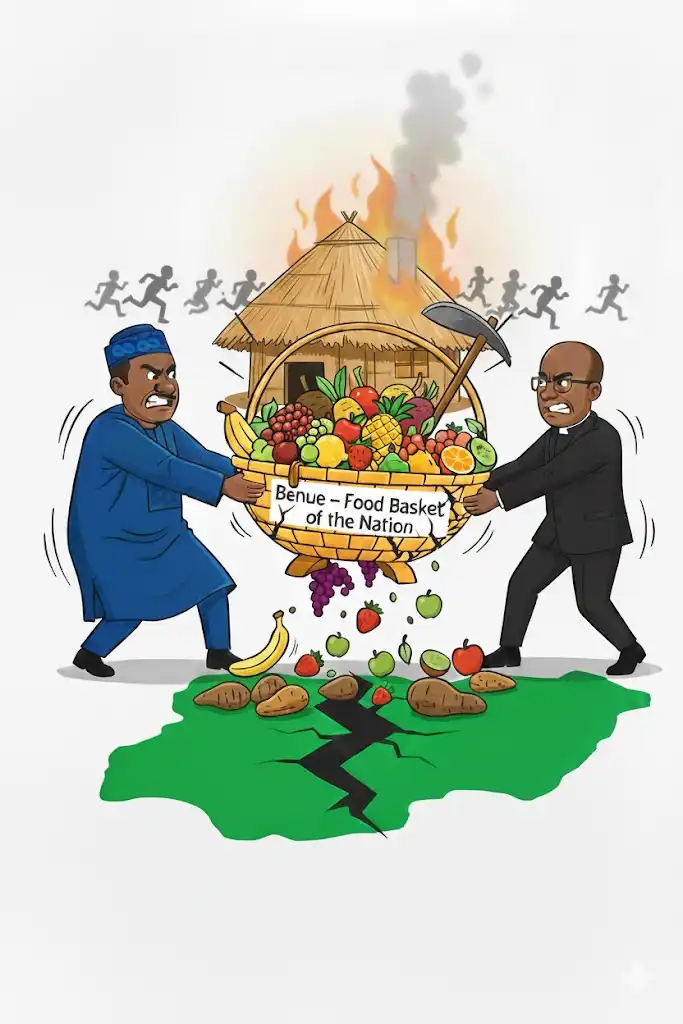
There is an African proverb that says, when two elephants fight, it is the grass that suffers. In Benue State today, that proverb is playing out in real time as a fierce political struggle between Secretary to the Government of the Federation (SGF), George Akume, and Governor Hyacinth Alia continues to deepen divisions and heighten tension across the state.
The political face-off, which began quietly shortly after the 2023 general elections, has since grown into a full-blown power tussle with consequences far beyond party politics, threatening governance, peace, and stability in Nigeria’s acclaimed “Food Basket of the Nation.”
It is no secret that Governor Alia’s rise to power was largely engineered by Akume. Until his foray into politics, Alia was a Catholic priest, widely known for his healing masses and spiritual influence.
IDOMA VOICE reports that Alia’s popularity cut across communities, particularly in a state where Catholicism holds strong sway.
When the All Progressives Congress (APC) needed a formidable candidate to challenge the Peoples Democratic Party (PDP)-backed Titus Uba, who enjoyed the support of then Governor Samuel Ortom, Akume turned to Alia. Leveraging Alia’s wide appeal and moral standing, the APC struck gold. Alia won the 2023 governorship election convincingly, ending PDP’s hold on the state.
For many, it was a classic political masterstroke. For others, it marked the beginning of a fragile alliance built more on convenience than consensus.
The relationship between the political godfather and his protégé began to show visible cracks shortly after Governor Alia’s inauguration. The first major flashpoint was the race for the Speaker of the Benue State House of Assembly.
Akume reportedly backed a different candidate, while Governor Alia insisted on Hyacinth Dajoh. In the end, the governor had his way. Dajoh emerged Speaker, signaling an early assertion of independence by Alia and a quiet defeat for Akume’s camp.
That episode set the tone for what was to follow.
Less than a year into Alia’s administration, the once-celebrated “father-and-son” political relationship had deteriorated. One of the earliest casualties was Austin Agada, the then APC chairman in Benue State and a known loyalist of Akume.
Agada’s removal from office deepened the rift within the party and entrenched factional lines. From that point, it became clear that the crisis was no longer behind closed doors, it had spilled into the open.
The political tension recently turned violent in Gboko, Akume’s political stronghold, where supporters of both camps clashed during a political confrontation. The clash reportedly led to one person being stabbed, raising fears that the rivalry could spiral further out of control.
Observers warn that when political disagreements degenerate into street violence, the line between leadership struggle and public disorder becomes dangerously thin.
Concerned by the escalating feud, the Tor Tiv, Professor James Ayatse, intervened, convening meetings aimed at reconciling both leaders. Though public displays of unity followed those meetings, insiders say the reconciliation was largely cosmetic.
Behind the scenes, the power struggle continued unabated.
While the political heavyweights battle for control, Benue State continues to grapple with persistent insecurity and killings, especially in rural communities. Many residents now question the priorities of their leaders at a time when lives are being lost and communities displaced.
Civil society groups and political analysts argue that the ongoing feud has distracted governance, weakened party cohesion, and slowed decisive action on security and development.
“Benue is bleeding,” a political analyst noted. “And instead of rallying forces to confront insecurity, the leadership is consumed by internal battles.”
As the Akume-Alia rivalry intensifies, the stakes are rising, not just for Benue, but for Nigeria at large. Benue’s strategic role in national food security means that prolonged instability could have ripple effects beyond state borders.
The question now confronting both leaders is simple but urgent: will power prevail over people, or will leadership rise above rivalry?
Until that question is answered, the grass, Benue’s people, will continue to suffer beneath the feet of fighting elephants.



Military Pension Board: Onoja Declares Full Support for Abdulraheem

Police confirm abduction of 14 JAMB UTME candidates in Otukpo, Benue

Gunmen kidnap 18 passengers in Benue Links bus attack in Otukpo

Army foils abduction, rescues two victims in Benue

Late Brigadier General Braimah, others buried with full military honours in Maiduguri

BREAKING: 2027 will be my last attempt at the presidency – Atiku

‘I’ll send you to scatter them, they’re already confused’ – Tinubu tells Akpabio
Why ADC lost Anambra, FCT polls – Aregbesola

‘Road to Aso Rock begins now’ – David Mark speaks as ADC alters constitution at convention

Herdsmen Declare War on Idoma Community – Untold story of Edikwu-Ankpali massacre

Gov Alia orders immediate flush-out of armed herders from Benue forests