
Benue news
Benue at 50: Idoma still shut out of power

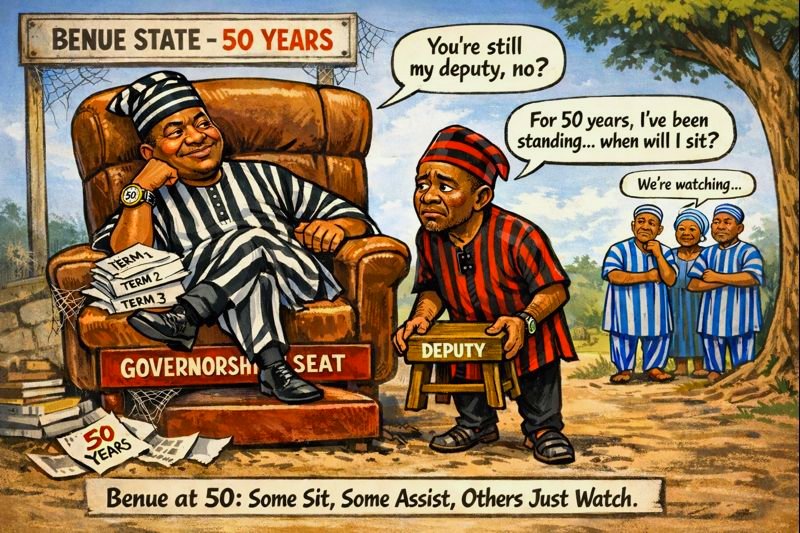
Today, February 3, marks 50 years since Benue State was created out of the former Benue–Plateau State by the military government of General Murtala Mohammed.
Ordinarily, such a milestone should inspire pride, reflection and celebration. For many citizens, however, particularly in Benue South, the golden jubilee is also a moment of sober reflection on a troubling political history marked by imbalance, marginalisation, and uneven development.
For five decades, the people of Benue South, predominantly Idoma, have demonstrated loyalty to the Benue project. They have served dutifully as deputies, stabilisers, and political allies. Yet, despite this long record of commitment, no Idoma person has ever been elected governor of the state.
Since its creation in 1976, Benue has been governed exclusively by Tiv political leaders: Aper Aku, Moses Adasu, George Akume, Gabriel Suswam, Samuel Ortom, and the incumbent, Hyacinth Alia.
Each administration has operated with the support of deputies and political stakeholders from Benue South, ensuring continuity and cohesion.
However, that loyalty has rarely translated into genuine political inclusion at the highest level.
This long-standing pattern has reinforced perceptions of exclusion among the Idoma people, who argue that their cultural, economic, and political contributions to the state have not been fairly recognised.
The issue is not competence or capacity; Idoma sons and daughters have excelled nationally in public service, academia, business, and the military. The question, therefore, is not whether Benue South can lead, but why it has never been given the opportunity.
Political imbalance has also reflected in the state’s development trajectory.
Over the past five decades, major infrastructure and public investments have been concentrated largely in Tiv-majority areas, while many communities in Benue South continue to grapple with poor road networks, under-equipped hospitals, and underfunded schools.
Towns such as Otukpo, Apa, and Ogbadibo have often lagged behind, reinforcing a persistent sense of neglect.
This pattern becomes even more concerning when Benue is compared with other states created in 1976, such as Anambra, Bauchi, Borno, Imo, Niger, Ogun, Ondo, Oyo, and Plateau, which, despite their own challenges, have made notable progress in infrastructure, industrial growth, and human development.
Benue, blessed with fertile land, rich agricultural potential, and a vibrant population, has underperformed. Many analysts attribute this to over-centralised political power and uneven allocation of resources, which stifle innovation and inclusive growth.
At 50, Benue State stands at a defining crossroads. This is no longer a debate driven by ethnic sentiment, but one anchored in justice, fairness, and the long-term stability of the state.
No society can thrive when leadership is perceived as the exclusive preserve of one group, while others are expected to remain perpetual supporters.
The Idoma are not asking for domination. They are asking for inclusion. True unity is built on equity, not imbalance; on opportunity, not tokenism. Power rotation, balanced appointments, and equitable development are not threats to Benue’s unity, they are essential to its survival.
As the state marks its golden jubilee, the pressing question remains: What should the next 50 years look like? A continuation of old patterns, or a new era where every section of the state has a genuine sense of belonging?
For Benue South, this anniversary should serve as a moment of renewed resolve, to organise, to engage politically, and to insist, peacefully and democratically, that loyalty to Benue must finally be matched with opportunity.
Fifty years is long enough to wait. If Benue’s future is to be strong, just and united, it must be inclusive.







2027: Iyabo Obasanjo meets Tinubu, declares Ogun governorship ambition

OccupyINEC: Atiku, Obi, David Mark, others storm ADC protest over INEC actions

BREAKING: Vehicles trapped in traffic as rainstorm damages Kugbo Bus Terminal in Abuja

Turkey: Wilfred Ndidi faces one-game suspension

Displaced man allegedly takes own life in Jato Aka, Benue

Benue: Suspected herdsmen kill Mother, three sons in Guma

Nigerian govt expels controversial American missionary Alex Barber

Heaven won’t fall if ADC, PDP miss ballot – Lagos APC

Protect Benue residents or step down – APC guber aspirant tells Alia

BREAKING: ADC youths give INEC 72-hour deadline, threaten nationwide protest

Fresh bodies recovered as Benue Easter attack death toll hits 11
