
Nigeria News
Security around Tinubu’s son enough to foil Benin Republic revolt –Wole Soyinka

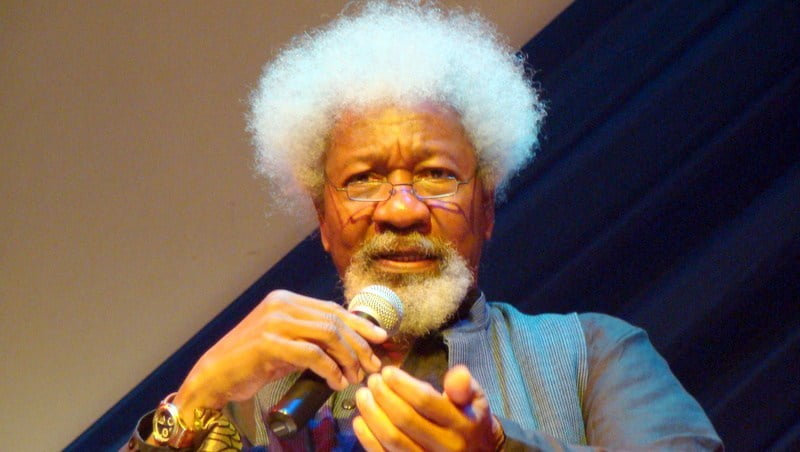
Renowned Nobel laureate, Prof. Wole Soyinka, has raised concern over what he described as an overwhelming concentration of security personnel around the son of President Bola Tinubu, cautioning that such an arrangement sends the wrong signal at a time Nigeria is battling insecurity.
The respected writer made the remarks on Tuesday while delivering his address at the 20th Wole Soyinka Centre for Investigative Journalism (WSCIJ) Awards held in Lagos.
He narrated how he was taken aback by the sheer presence of armed operatives attached to the president’s son at a hotel in Ikoyi.
According to Soyinka, his first thought was that a movie production was underway due to the large concentration of uniformed men on the premises.
“I was coming out of my hotel, and I saw what looked like a film set,” he said. “A young man detached himself from the actors, came over and greeted me politely.
When I asked if they were shooting a film, he said no. I looked around and there was nearly a whole battalion occupying the hotel grounds.”
He further revealed that roughly 15 fully armed security operatives were stationed as the protective cover for the president’s son an arrangement he found deeply troubling.
“When I got back in my car and asked the driver who the young man was, he told me. And I saw this SWAT team, heavily armed to the teeth.
They looked sufficient to take over a neighbouring small country or city like Benin,” he said.
Disturbed by what he witnessed, the playwright explained that he immediately tried to reach the National Security Adviser (NSA) to confirm whether such a deployment had official backing.
“I began looking for the NSA immediately. I said, track him down for me. They got him somewhere in Paris, but he was in a meeting with the president.
I described the scene and asked: ‘Do you mean a child of the head of state goes around with an army for his protection?’ I couldn’t believe it.”
With biting sarcasm, Soyinka remarked that the nation would hardly need to mobilise the military or air force in the event of unrest in neighbouring countries since such a powerful force already follows the president’s son.
“Tinubu didn’t have to send the air force or military to deal with any insurrection. There is an easier way,” he said.
“Next time there’s an uprising, the president should call that young man and say, ‘Seyi, go and put down those stupid people there. You have troops under your command.’”
The literary icon stressed that although leaders naturally have families, national security must not be compromised for personal privilege.
“Children should know their place. They are not potentates; they are not heads of state,” he said.
“The security architecture of a nation suffers when we see such heavy devotion of security to one young individual.”
Soyinka’s comments have further ignited discussions nationwide over the extent of state-backed security assigned to politically connected persons, especially at a time when many communities continue to grapple with serious



FULL LIST: Godstime Iyare, Eze Okpoto, Yan Group NLBDG named among 48 individuals, groups linked to terrorism financing in Nigeria

Suspected herdsmen attack Agatu community, kill farmer

Bishop Oyedepo, Ibiyeomie to dedicate Master’s Place Dreamland City Mega Complex July 17

Nigerian govt names 48 people, groups over alleged terrorism financing

FG slashes import duties on rice, cars, drugs in new tariff policy

FG orders revocation of passports of Nigerians who renounced citizenship

‘I lost my wife, kids, then herdsmen killed my parents’ – Idoma son, Otache battles pain after losing entire family

No zoning approval yet — Benue APC

Benue Assembly approves four bills to strengthen infrastructure, others

JAMB delists 23 CBT centres in 11 states, FCT over 2026 mock UTME issues

David Mark-led ADC seeks court order to reverse INEC decision
