
Nigeria News
Senate explains delay on bill to criminalise dual party membership

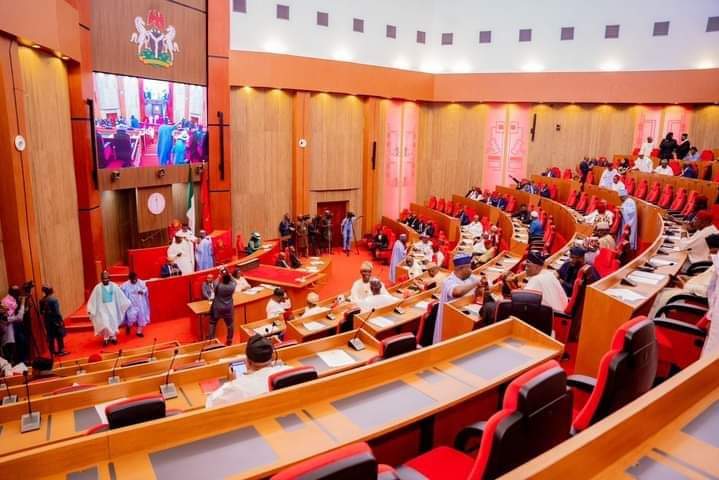
The Nigerian Senate has explained why it has not taken a stance on the proposed amendment to the Electoral Act that seeks to criminalise dual party membership, noting that the bill has yet to be formally forwarded from the House of Representatives.
Chairman of the Senate Committee on Media and Publicity, Yemi Adaramodu, stated that the upper legislative chamber cannot debate or comment on a proposal that has not officially reached it.
“Even if any amendment is coming, we are running a bicameral legislature. So, we can’t comment on it until it gets to us,” he said.
Adaramodu emphasised that proper legislative procedures must be completed in the House of Representatives before the Senate can consider the bill.
He outlined that any proposed law must first pass first and second readings in the lower chamber, undergo a public hearing, be debated and approved, and only then be transmitted to the Senate for concurrence.
Speaking in an interview with The PUNCH, he reiterated that the Senate cannot formally engage with the amendment until these processes are concluded.
The proposed amendment to the Electoral Act 2026 aims to outlaw membership of more than one political party, nullify such affiliations, and introduce tougher penalties for offenders.
Under the bill, violators could face a fine of ₦10 million, up to two years in prison, or both upon conviction. It also stipulates that individuals found guilty of dual membership would lose recognition across all political parties until their status is regularised.
The proposal is intended to tackle persistent issues such as political defections, manipulation of party registers, and weak enforcement of party discipline.
While existing regulations discourage multiple party affiliations, enforcement has largely remained administrative, with little in terms of criminal sanctions.
For the amendment to take effect, it must be approved by both chambers of the National Assembly of Nigeria and subsequently signed into law by the President. Until then, the Senate insists it cannot adopt an official position on the matter.












FULL LIST: Godstime Iyare, Eze Okpoto, Yan Group NLBDG named among 48 individuals, groups linked to terrorism financing in Nigeria

Suspected herdsmen attack Agatu community, kill farmer

Bishop Oyedepo, Ibiyeomie to dedicate Master’s Place Dreamland City Mega Complex July 17

Nigerian govt names 48 people, groups over alleged terrorism financing

FG slashes import duties on rice, cars, drugs in new tariff policy

FG orders revocation of passports of Nigerians who renounced citizenship

‘I lost my wife, kids, then herdsmen killed my parents’ – Idoma son, Otache battles pain after losing entire family

No zoning approval yet — Benue APC

Benue Assembly approves four bills to strengthen infrastructure, others

JAMB delists 23 CBT centres in 11 states, FCT over 2026 mock UTME issues

David Mark-led ADC seeks court order to reverse INEC decision
