
Benue news
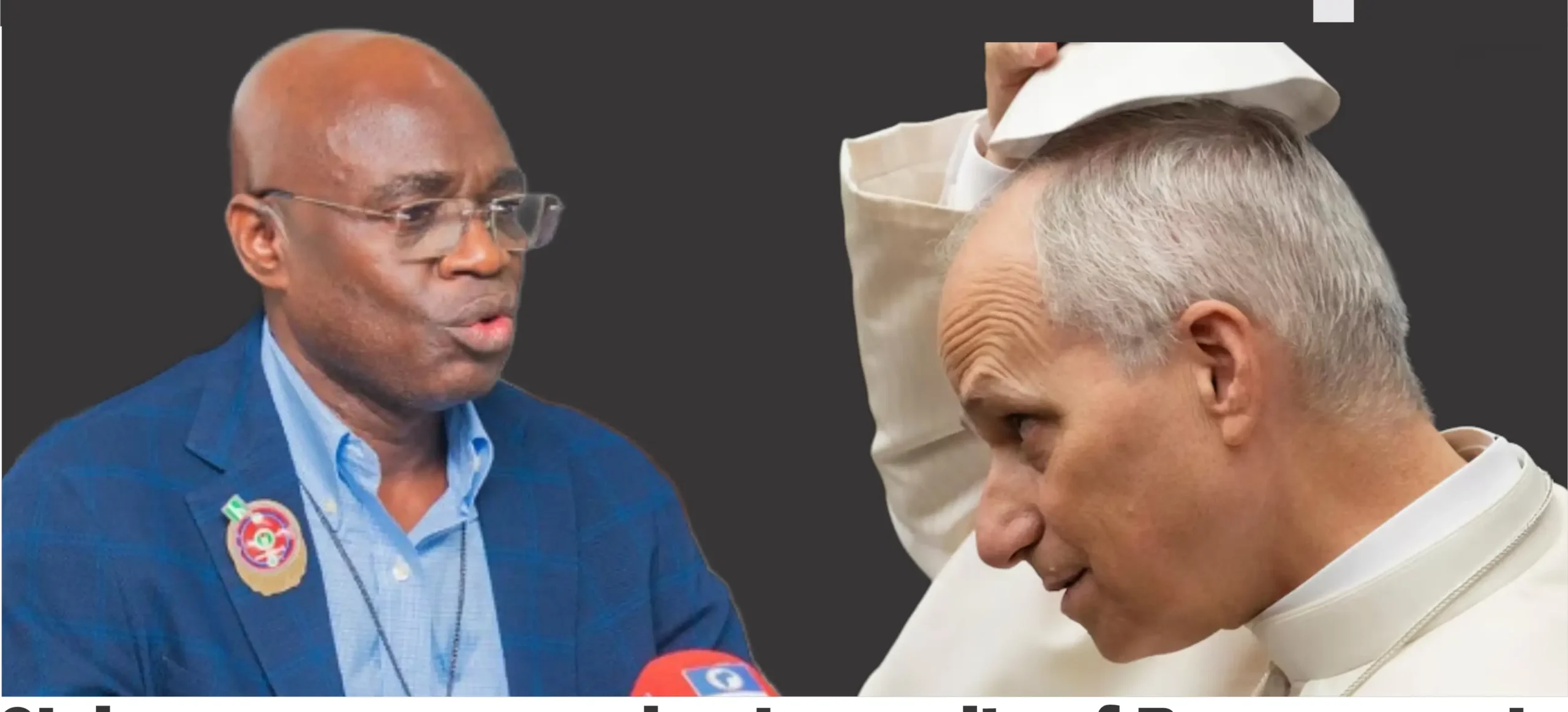
The Pope Must Hear This: Why Benue politician dragged Rev Fr Alia before Pope Leo [DETAILS]

1st September, 2025
His Holiness Pope Leo XIV
Supreme Pontiff of the Catholic Church and Sovereign of Vatican City State
Through:
Archbishop Michael Francis Crotty
The Apostolic Nuncio, representing the Holy See
Nigeria
Your Holiness,
URGENT APPEAL FOR INTERVENTION REGARDING THE INVOLVEMENT INTO PARTISAN POLITICS OF REV. FR. HYACINTH IORMEM ALIA, EXECUTIVE GOVERNOR OF BENUE STATE, NIGERIA
A Petition Concerning the Protection of the Catholic Church’s Reputation in Nigeria
I write to you as a devout Nigerian Catholic, baptised into the faith in 1974 and raised within a family that holds steadfast to the Church’s traditional doctrines and moral teachings. Whilst I am by profession an established businessman and trained journalist who has recently engaged in political affairs, I address Your Holiness today purely in my capacity as a concerned Catholic who feels duty-bound to defend the Church and its teachings.
The purpose of this petition is to bring to Your Holiness’s attention the conduct of Rev. Fr. Hyacinth Alia, an ordained priest who entered politics and was elected Governor of Benue State, Nigeria, on 29th May 2023. His subsequent actions in office have caused considerable
concern amongst the faithful and pose a significant threat to the reputation of the Catholic Church in Nigeria.
Background and Context
The people of Benue State, who are overwhelmingly Christian with a Catholic majority, elected Rev. Fr. Alia primarily because they had grown disillusioned with traditional politicians who made extensive campaign promises but delivered little once in office. The electorate placed their trust in a priest, believing his sacred calling would translate into honest, moral governance.
Tragically, after more than two years in office, Governor Alia has not merely underperformed but has conducted himself in ways that make his secular predecessors
appear virtuous by comparison. The state has descended into despair, and alarmingly, public
resentment is beginning to extend beyond the governor to the Church itself.
Principal Concerns
Corruption and Lack Accountability
Financial corruption under Governor Alia has reached unprecedented levels in Benue State’s history. The Zebra Reporters, an online publication, has documented allegations of massive corruption amounting to ₦345.3 billion (approximately $225.6 million) through dubious contract awards over the past two years. These contracts were allegedly awarded without due process, budgetary provision, or State Executive Council approval.
Despite these enormous expenditures, no meaningful projects have been commissioned,
leaving the state with impassable roads and a complete absence of basic amenities. This financial mismanagement created such tension between the governor and the State Assembly that the state was effectively paralysed for weeks, culminating in the forced
resignation of the Assembly Speaker.
Political Divisiveness and Institutional Conflicts
Since assuming office, Rev. Fr. Alia has engaged in destructive conflicts with virtually every institution and individual who disagrees with him. He has quarrelled with the political
mentors who helped secure his election, attempted to forcibly assume control of his party’s
leadership, and created such division that the party split into hostile factions. His actions
have fostered hatred, bitterness, and in some instances, actual violence amongst party members. Although the President of Nigeria, as the party leader, has made considerable efforts to resolve the conflict, Rev. Fr. Alia has not supported the peace process and has instead taken actions perceived as promoting hostilities.
Furthermore, the actions initiated by the governor concerning the state judiciary resulted in the closure of the courts for several months, as a protest against his efforts to remove the state Chief Judge, with whom he had disagreements, outside of lawful procedures. These developments had a substantial impact on the stability of democratic institutions within the state.
Most troublingly, the governor has engaged in public conflict with the Catholic Church itself – the very institution whose reputation facilitated his election. Benue State encompasses four Catholic dioceses, yet Governor Alia maintains frosty relations with the
bishops and his fellow priests. During his campaign, his supporters publicly abused the
Bishop of Makurdi for not supporting his candidacy, and this hostility has continued, with
the governor systematically excluding the Church from public functions and destroying the
collaborative partnership that had existed between the state and Church for years.
Incitement to Violence and Threats
In preparation for the 2027 elections, Governor Alia has been touring the state inciting
supporters to violence against potential challengers. He has made specific threats against contestants from the Kunav clan, reinforced by his known associates who have publicly stated that anyone daring to contest against Rev. Fr. Alia will face physical assault. These
threats are so serious that formal petitions have been filed with security agencies, including
the police and Department of State Security.
Governor Alia has cultivated a violent group called “No Alia, No Benue” and has boasted publicly that he will secure re-election “by whatever means, including diabolical.” Such conduct represents an unprecedented level of criminal intimidation in Benue State politics.
Compromise of Security and Betrayal of Public Trust
Perhaps most gravely, Governor Alia has compromised the security of his own people through his relationship with Fulani jihadists. Prior to his election, the state had successfully implemented anti-open grazing legislation that significantly reduced attacks by these groups masquerading as herdsmen. However, during his campaign, Rev. Fr. Alia reportedly assured these jihadists that he would repeal this protective legislation if elected.
Upon assuming office, he dismantled the structures established by the anti-grazing law, leading to a renewed wave of murderous attacks. The recent assault on Yelwata, where over
200 people were killed, drew international attention. Rather than leading the state in mourning, Governor Alia displayed shocking insensitivity by celebrating during the President’s condolence visit.
The Church’s Moral Authority at Stake
Your Holiness, the Catholic Church in Nigeria has long been recognised as a champion of good governance, accountability, and human development. For centuries, the Church has provided essential services – education, healthcare, and social amenities – often where government has failed to do so. The Church’s non-discriminatory approach has earned respect across religious boundaries, with many Muslims benefiting from Catholic institutions.
The Nigerian Bishops’ Conference has consistently held governments accountable whilst maintaining moral authority. Leaders such as Archbishop Emeritus Anthony Okogie, Cardinal John Onaiyekan, and Bishop Matthew Kukah have fearlessly challenged successive governments without compromising their sacred calling.
The Church’s position on corruption is unequivocal, as evidenced by the special prayer against bribery and corruption recited at every Sunday Mass across Nigeria. This prayer
acknowledges Nigeria’s abundant blessings whilst lamenting their misuse through “acts of
injustice, bribery and corruption” that leave many people “hungry, sick, ignorant and defenceless.”
Rev. Fr. Alia, having led congregations in this prayer countless times, now governs in direct contradiction to its spirit and the Church’s teachings. His conduct raises the troubling question: if the Church has historically held governments accountable even under military regimes, why does it remain silent when one of its own priests misgoverns a state populated largely by Catholic adherents?
Urgent Need for Intervention
Your Holiness, the faithful in Nigeria are deeply troubled by this situation. Rev. Fr. Alia’s conduct is not merely disappointing; it actively undermines the Church’s moral authority and threatens to divide both the Church and its followers. The reputation and legacy that the
Catholic Church has built over centuries in Nigeria hangs in the balance.
The Nigerian Catholic community looks to Your Holiness for guidance and action. The Church’s credibility depends upon its willingness to uphold the same standards for its own members that it demands of secular leaders. Rev. Fr. Alia’s continued misconduct whilst
wearing the moral mantle of priesthood causes scandal to the faithful and provides ammunition to the Church’s critics.
Prayer and Appeal
I humbly and fervently appeal to Your Holiness to take a decisive stand regarding Rev. Fr. Alia’s role in politics and its impact upon the Church. His misconduct is dividing the Church, undermining its reputation, and causing scandal to the faithful. The situation requires urgent intervention to preserve the integrity of the Catholic Church in Nigeria and to reaffirm the
Church’s commitment to the moral principles it has always championed.
May Your Holiness consider this appeal with the wisdom and pastoral care that have
characterised your pontificate, and may the Almighty guide your decisions in this matter.
Your Holiness, I remain your obedient son in Christ.
Mr. Joseph Waya
Cc:
1. Archbishop Ignatius Ayau Kaigama
The Archdiocese of Abuja.
2. Bishop Wilfred Anagbe
Catholic Diocese of Makurdi.
3. Bishop William Amove Avenya
Catholic Diocese of Gboko.
4. Most Rev. Isaac Bundepuun Dugu
Catholic Bishop of Katsina-Ala.
5. Most Rev. Dr. Michael Ekwoy Apochi
Catholic Bishop of Otukpo.
6. Catholic Bishops Conference of Nigeria.



Benue: Police inspector shot dead by gunmen in Makurdi, rifle stolen

Gunmen abduct 24-year-old herder in Otukpo, demand N4m ransom

2027: Resign before March 30 if you want to contest — Gov Alia tells appointees

Nigerian govt not accepting foreign deportees – Presidency

Wale Adenuga trademarked my stage name – Pa James opens up

Arsenal must prove they can win trophies – Arteta

CONFIRMED: Ronaldo dropped from Portugal’s squad

We have started ending insecurity in Benue – Gov Alia

Delta: Police arrest five over assault of women at Ozoro Festival

Iran confirms death of top official, Ali Mohammad in US-Israel airstrike

BRM insists Idoma must produce Benue Governor in 2027
