
Nigeria News
US increases arms, intelligence support to Nigeria against IS-linked militants

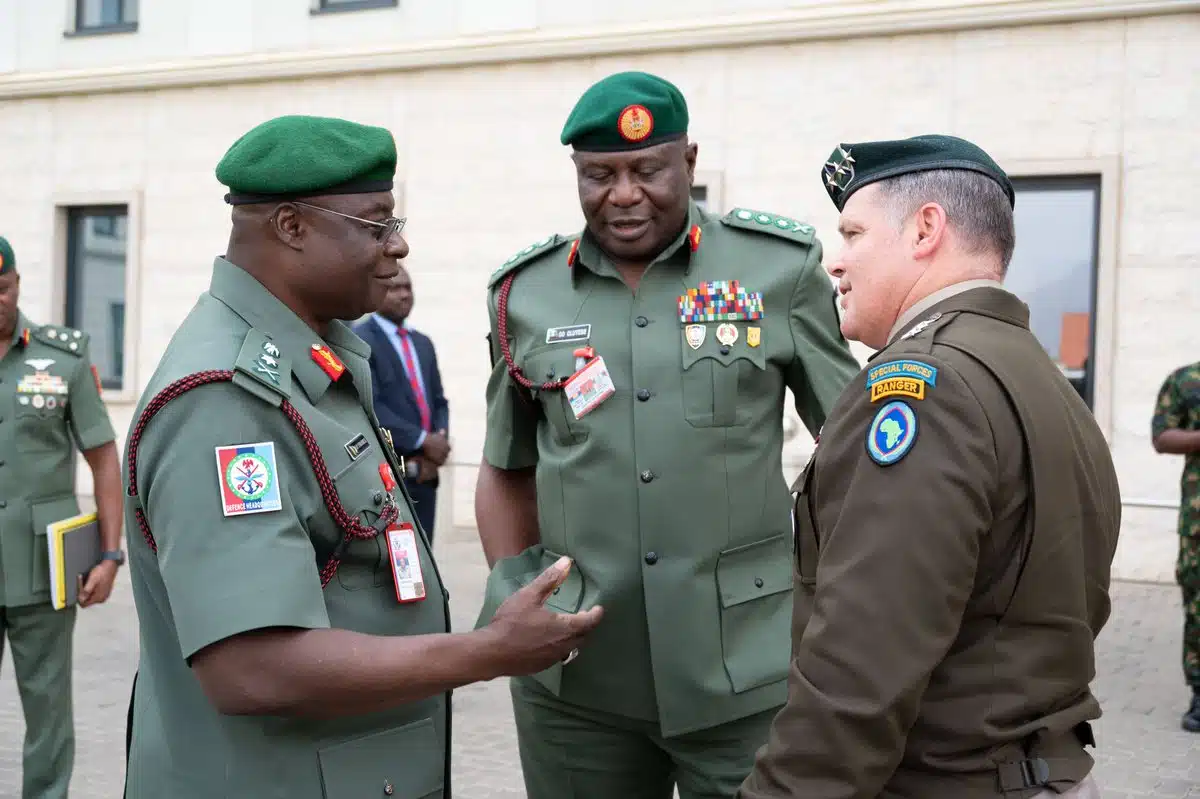
The United States has intensified military support for Nigeria by expanding the supply of equipment and increasing intelligence cooperation as part of a wider strategy to counter Islamic State (IS)-linked militant groups across Africa.
This was disclosed by the Deputy Commander of the United States Africa Command (AFRICOM), Lt.-Gen. John Brennan, during an interview with AFP on the sidelines of a recent US–Nigeria security meeting held in Abuja.
According to Brennan, Washington has shifted towards a more assertive posture in confronting IS-affiliated groups operating across the continent.
“Under the Trump administration, we’ve gotten a lot more aggressive and are working with partners to target, kinetically, the threats, mainly ISIS,” he said.
Brennan noted that militant networks across Africa are interconnected, making regional cooperation critical to dismantling their operations.
“From Somalia to Nigeria, the problem set is connected. So we’re trying to take it apart and then provide partners with the information they need.”
He further explained that the US is prioritising the empowerment of partner nations by easing restrictions on military assistance.
“It’s been about more enabling partners and then providing them equipment and capabilities with less restrictions so that they can be more successful,” Brennan said.
The renewed cooperation follows the inaugural US–Nigeria Joint Working Group meeting, which took place roughly a month after the United States conducted surprise Christmas Day airstrikes on IS-linked targets in northwestern Nigeria.
Brennan stated that future American assistance would largely focus on intelligence sharing to strengthen Nigerian air operations in both the northwest and northeast, regions affected by long-running insurgencies involving Boko Haram and its offshoot, the Islamic State West Africa Province (ISWAP), which have plagued the country since 2009.
He described ISWAP as “our most concerning group.”
The enhanced military collaboration comes amid diplomatic tensions, with Washington facing pressure over allegations of widespread killings of Christians in Nigeria.
However, Nigerian authorities and several independent analysts have rejected that narrative, stressing that insecurity in the country affects communities regardless of religious affiliation.
The issue was raised during the Joint Working Group meeting, where a US State Department official, Allison Hooker, urged Nigeria to safeguard Christians in a speech that did not reference Muslim victims.
Brennan, however, clarified that US intelligence assistance would not be restricted to the protection of Christians alone.
In recent months, analysts have observed an uptick in US intelligence surveillance flights over Nigerian territory, though concerns remain over whether air operations alone can significantly degrade militant groups operating in regions marked by poverty and limited government presence.
The earlier US airstrikes reportedly targeted fighters associated with the Islamic State Sahel Province, a faction more active in neighbouring Niger.
Brennan cautioned that the expansion of IS-linked groups from the Sahel region into coastal West African countries, including Nigeria, poses a growing threat.
The full impact of the strikes is still uncertain, as independent verification of militant casualties has not been possible.
Nigeria’s Minister of Information, Mohammed Idris, stated last week that the military operation was “still a work in progress.”
Brennan also revealed that despite strained diplomatic relations, the US continues to maintain communication with the armed forces of Burkina Faso, Mali and Niger, countries currently under military rule.
“We still collaborate,” he said, noting that intelligence has been shared with some of the countries to counter terrorist threats.
“We still talk to our military partners across the Sahelian states, even though it’s not official,” Brennan added.
He further emphasised that Washington has no plans to establish new military bases in West Africa following the closure of its drone facility in Agadez, Niger.
“We’re not in the market to create a drone base anywhere,” he said.
“We are much more focused on getting capability to the right place at the right time and then leaving. We don’t seek long-term basing in any of the West African countries.”



Nigerian newspapers headlines for today, Thursday, 19th February 2026

Benue: 14 abducted Igede travellers regain freedom after N1m ransom

Teacher, spouse slain as armed men attack Benue community

Benue: 23-year-old man killed after fight with neighbour over palm fruit

37 miners dead, 25 hospitalised after suspected gas leakage in Plateau

Courts are last line of defense against election fraud – Adeyanju

Cardi B confirms breakup with Stefon Diggs amid cheating claims

Father storms Gym with police to arrest man accused of impregnating daughter

Over 30 Plateau indigenes killed, 707 displaced in Kwara attack – Riyom Deputy Chairman
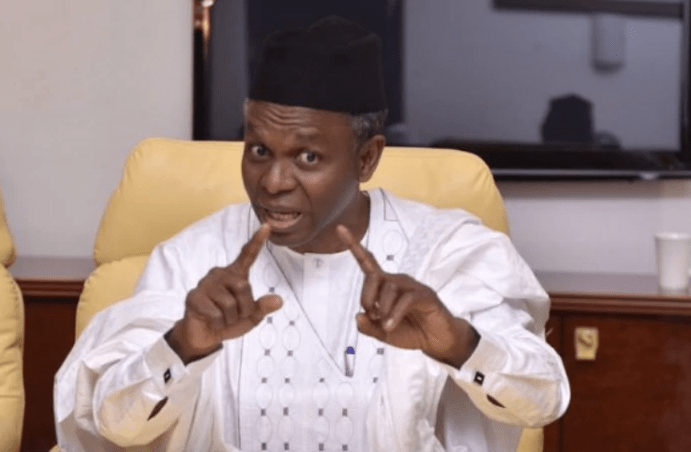
El-Rufai spends second night in EFCC custody over N432bn probe

Benue CP decorates 456 newly promoted officers
