
Benue news
EXCLUSIVE: Federal University of Health Sciences Otukpo medical students trapped in 300 level over accreditation crisis

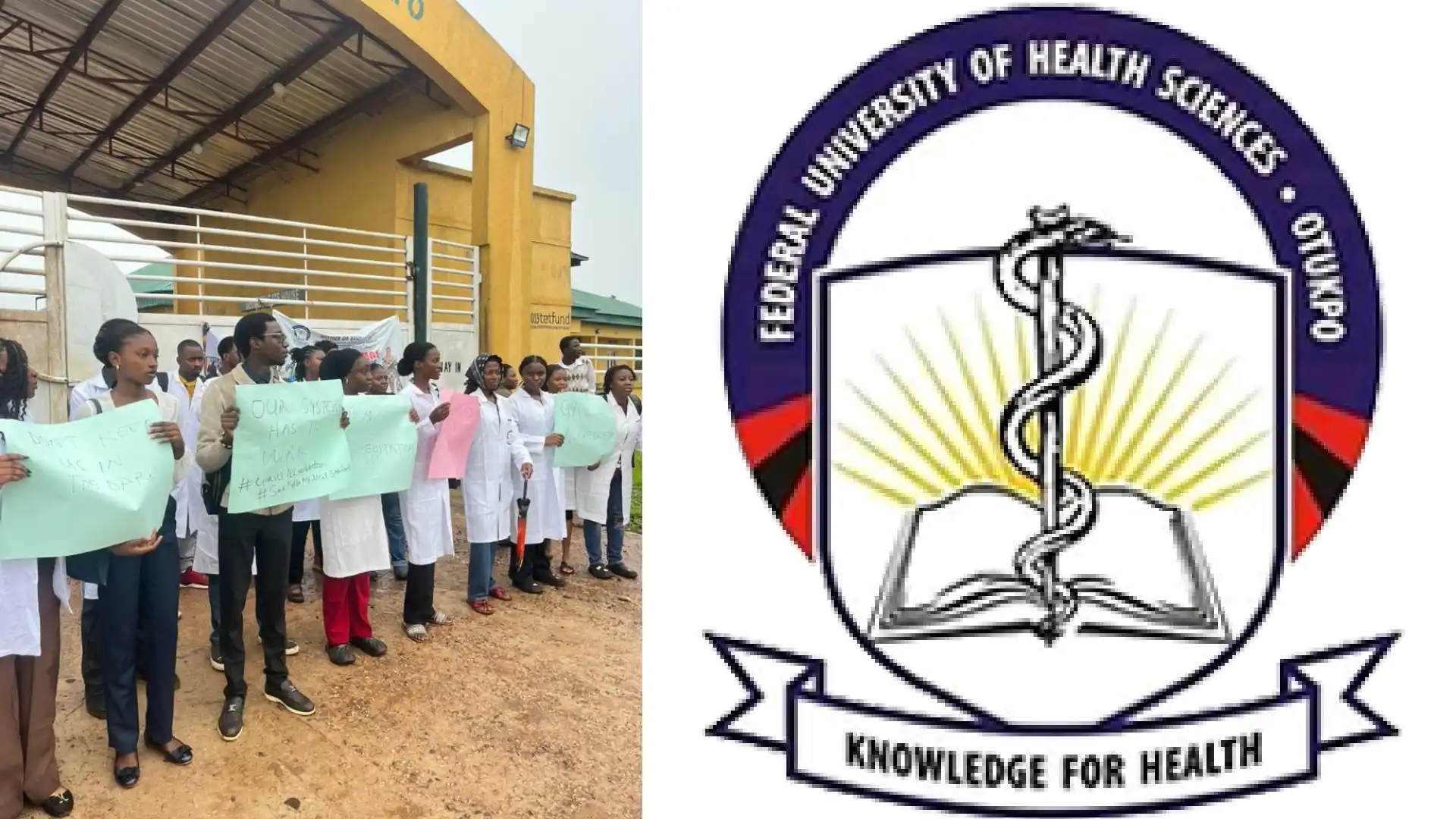
For many medical students of the Federal University of Health Sciences, Otukpo (FUHSO), the dream of becoming doctors is gradually turning into frustration, uncertainty and emotional exhaustion, IDOMA VOICE reports.
What was meant to be a six-year journey into the medical profession has now stretched endlessly for some students who have remained stranded in 300 level for up to three years due to the university’s inability to secure accreditation for its medical programme.
The situation recently exploded into open protest as angry students blocked the school gate, demanding answers from the management over years of delays and uncertainty.
FUHSO was established in 2020 as one of Nigeria’s specialized federal universities focused on health sciences and medical training.
However, nearly six years later, the university is yet to secure full accreditation for its Medicine and Surgery programme, a development that has left students unable to proceed to clinical studies.
Without accreditation, medical students cannot move beyond the pre-clinical stage into hospital-based clinical training, effectively trapping them academically.
According to affected students, management repeatedly assured them that accreditation issues would soon be resolved, but the promises have continued without visible results.
“We have been hearing promises for years,” one student told IDOMA VOICE.
“Every time they tell us they are working on accreditation, but nothing changes.”
Three Years Stuck in 300 Level
The crisis has become particularly severe for students currently in 300 level.
There are reportedly two streams: Stream A and Stream B.
While Stream A students have spent three years in 300 level, Stream B students have spent two years waiting for approval to proceed to clinicals.
Ironically, members of Stream A are supposed to be graduating this year if the academic calendar had progressed normally.
Instead, many remain trapped at the same academic level they occupied years ago.
According to students, the prolonged delay has taken a devastating emotional and academic toll.
Some reportedly abandoned the programme entirely.
Others rewrote JAMB and switched to different courses or institutions after losing hope that the university would ever secure accreditation.
“It was only last month they asked many of them to come back to school,” another student told our reporter.
“Some people had already moved on with their lives because they lost hope.”
Protest Erupts on Campus
Frustration finally boiled over as students from Medicine, Nursing, Medical Laboratory Science (MLS), and other departments staged a protest on campus on Monday.
Students from 100 level to 300 level joined the demonstration to demand clarity from management over the future of the medical programme.
According to eyewitnesses, the vice chancellor, Prof. Francis Aba Uba arrived during the protest and requested that students reopen the school gate before he could address them.
However, the students refused, insisting that they wanted immediate answers first.
“The students felt management had continued to fail them,” a source said.
The Vice Chancellor reportedly became angry and left the scene after students refused to reopen the gate.
Security operatives were later invited to the campus, but students reportedly stood their ground until an officer appealed to them before they eventually dispersed around noon.
Management Orders Students Out
Shortly after the protest, the university management issued an internal memorandum directing all affected 300 level MBBS students in Streams A and B to proceed on immediate vacation.
The memo, dated May 18, 2026, and signed by the Registrar, Mr. Michael O. Ogiji, stated that the decision was taken by the university management on behalf of the Senate.
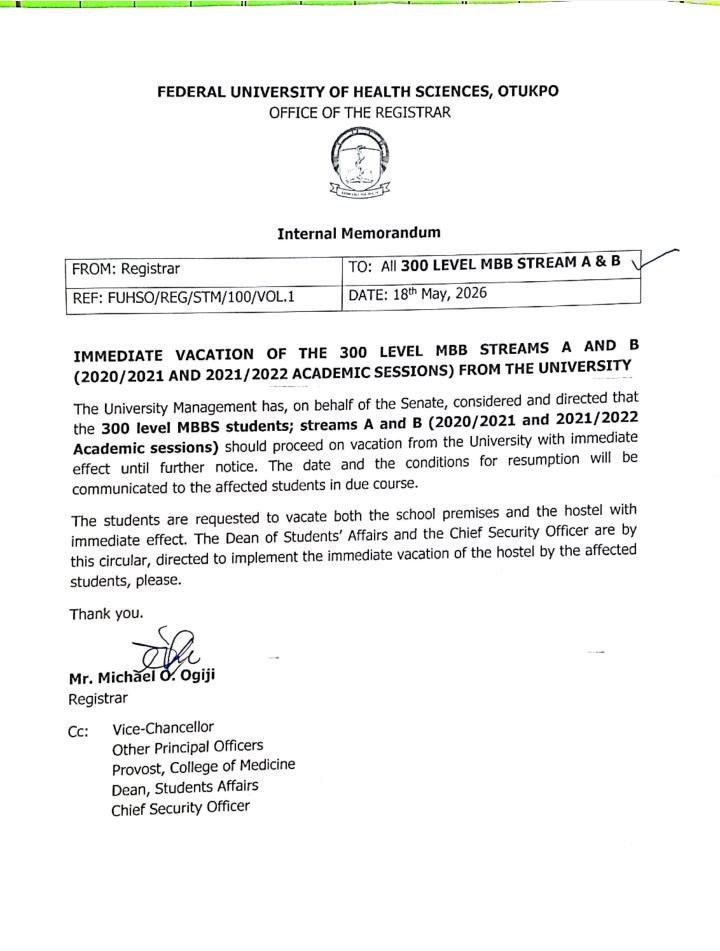
According to the circular, all 300 level MBBS students in the 2020/2021 and 2021/2022 academic sessions were directed to vacate both the school premises and hostels with immediate effect until further notice.
“The date and the conditions for resumption will be communicated to the affected students in due course,” the memo stated.
The directive has further intensified tensions on campus, with students already threatening additional protests.
For some students, the uncertainty has become emotionally draining.
“I don’t even understand this school anymore,” one frustrated student lamented.
“If I had known the school did not have accreditation, I probably would not have come here.
“If they fail to get accreditation before we reach 300 level too, we may also end up waiting for years before proceeding for clinicals.
“Honestly, I’m tired.”
The comparison fueling students’ anger
Part of the anger among students comes from comparisons with other newly established federal health universities across Nigeria.
Students pointed out that FUHSO was among the earliest specialized federal universities of health sciences to establish its medical programme.
However, institutions such as the Federal University of Health Sciences, Azare (FUHSA), and the Federal University of Health Sciences, Ila-Orangun (FUHSI), which were established later, have already secured accreditation and moved their medical students into clinical training.
Meanwhile, FUHSO students remain stranded at the pre-clinical stage with no definite timeline for resolution.
To many students, this has become difficult to understand.
“How can schools that came after us move ahead while we are still stuck?” another student asked.
Bigger Questions for Nigeria’s Education System
Beyond FUHSO, the crisis raises broader concerns about the rapid establishment of specialized universities without adequate infrastructure, staffing, teaching hospitals, and accreditation readiness.
Education stakeholders say medical education is too sensitive for prolonged uncertainty because delays affect not only students’ futures but also the country’s healthcare manpower development.
For now, hundreds of FUHSO students remain caught between hope and frustration, waiting for accreditation, waiting for answers, and waiting for a future they fear may continue slipping away.










Tanzania President, Samia Suluhu Hassan loses husband

Tanzanian President Samia Suluhu Hassan loses husband

US singer Ciara announces fifth pregnancy with Russell Wilson

‘You can’t’ — NELFUND boss rejects claims of political screening in student loans

After 20 years, FG moves to give Nigerian shipowners up to $25m each under CVFF

2027: Emama Ikwue receives royal blessing for Otukpo/Ohimini Reps bid

2027: Election rigging won’t happen under my watch – Peter Obi

Premier League matchweek 3: Arsenal, Man City maintain perfect starts as Chelsea lose

Chelsea continue remarkable early-goal trend after Arsenal defeat

I will not neglect Benue South like Alia if elected governor in 2027 – PDP’s Mike Aondoakaa vows

Assembly race: Ogaragbo takes 2027 campaign to Ado LP executives
