Connect with us

Nigeria News

11 years after arraignment, Suswam’s alleged N3.1bn money laundering case reaches final stretch

Published

on

…Court fixes September 25 for adoption of final written addresses

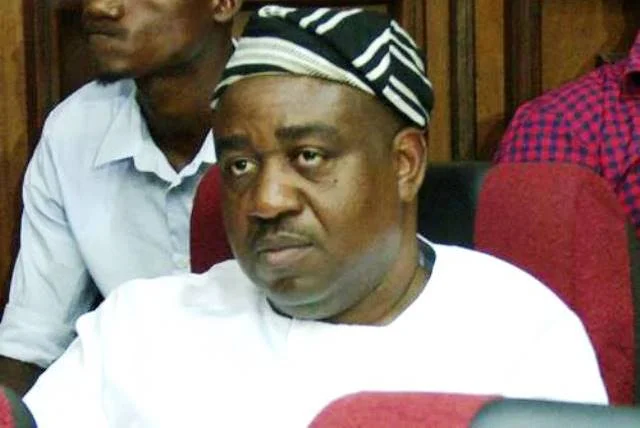
The alleged N3.1 billion money laundering case involving former Benue State Governor, Senator Gabriel Suswam, and his former Commissioner for Finance, Omadachi Okolobia, is set to enter its final stage on Friday, September 25, 2026.

Justice Peter Lifu of the Federal High Court sitting in Abuja had adjourned the matter for the adoption of final written addresses by the parties.

The case, instituted by the Economic and Financial Crimes Commission (EFCC), has lasted more than 11 years since Suswam and Okolobia were first arraigned in November 2015.

Suswam and Okolobia are facing an amended 11-count charge bordering on alleged money laundering and related offences involving N3.1 billion, which the EFCC alleges was proceeds from the sale of Benue State Government shares.

The prosecution alleges that the funds were linked to the sale of the state’s shares held through the Benue Investment and Property Company Limited (BIPC) and sold through Elixir Securities Limited and Elixir Investment Partners Limited.

The defendants have denied the allegations.

How the case got here

Suswam, who governed Benue State between 2007 and 2015, and Okolobia were first arraigned before Justice Ahmed Mohammed in November 2015.

The case subsequently suffered a series of delays and judicial changes.

Justice Mohammed initially withdrew from the case in June 2016 following a publication alleging that he had been compromised to give Suswam a “soft landing.” He later rescinded the decision after representations from the defence and prosecution.

However, following another publication making similar allegations, Justice Mohammed again withdrew from the case in July 2019.

The matter was subsequently reassigned to Justice Okon Abang, who commenced hearing and had four witnesses testify before the Court of Appeal ordered that the case file be returned to Justice Mohammed.

Following Justice Mohammed’s elevation to the Court of Appeal in 2023, the case was eventually reassigned to Justice Peter Lifu.

The trial started afresh before Justice Lifu on March 21, 2024, following the filing of an amended 11-count charge.

The EFCC called nine witnesses, including officials of the Benue State Ministry of Finance, EFCC investigators, a portfolio manager and a bureau de change operator.

One of the prosecution witnesses, Abubakar Umar, a bureau de change operator and Chief Executive Officer of Fanffash Resources, told the court that N3.1 billion was transferred to his account in tranches in 2014.

Umar testified that he converted the money to dollars and delivered the equivalent to Suswam at his Maitama residence in Abuja.

He said the first tranche of N413 million was transferred to his account on August 8, 2014, while subsequent transfers brought the total amount to about N3.1 billion.

Umar also told the court that the transfers were made by a woman whom, he said, Suswam had directed to send the money.

Another prosecution witness, Mustapha Yusuf Abubakar, an EFCC investigator, tendered documents relating to a portfolio agreement involving Elixir Securities Limited and Elixir Investment Partners Limited and the Benue Investment and Property Company.

The prosecution eventually closed its case.

In July 2025, Justice Lifu dismissed the defendants’ no-case submissions, ruling that the prosecution had established a prima facie case requiring the defendants to enter their defence.

The judge subsequently ordered the defendants to open their defence.

Suswam denies allegations

Suswam later testified as the sole defence witness and denied collecting money from Umar or instructing him to collect and convert money on his behalf. “At no time did I instruct him to collect the said amount, convert it and give it back to me as alleged in the charge,” Suswam told the court.

The former governor also denied misappropriating or stealing public funds during his eight years in office.

He urged the court to discharge and acquit him, insisting that his record in public service was without blemish.

His co-defendant, Okolobia, also denied wrongdoing and told the court that he acted under instructions from Suswam.

After the defence closed its case, Justice Lifu fixed the matter for the adoption of final written addresses.

The matter was initially scheduled for January 20, 2026, but the court did not sit on that date.

It was subsequently adjourned several times, including to July 16, when the adoption of the final addresses was again stalled by Suswam’s absence from court.

At the July 16 proceedings, EFCC counsel, Rotimi Jacobs, SAN, opposed another lengthy adjournment, pointing out that the case had been pending for 11 years. Suswam’s counsel, Paul Erokoro, SAN, had informed the court that his client and counsel could not attend on health grounds.

Justice Lifu, however, adjourned the matter to September 25 for the adoption of final written addresses.

The adoption of final written addresses is the final stage of arguments before the court considers the evidence and delivers judgment.

After more than a decade of proceedings, judicial reassignments and adjournments, attention is now on the Federal High Court as the parties return for the adoption of their final addresses.