
Benue news
Brothers at War: Akume, Alia’s battle for Benue APC leadership gets messier

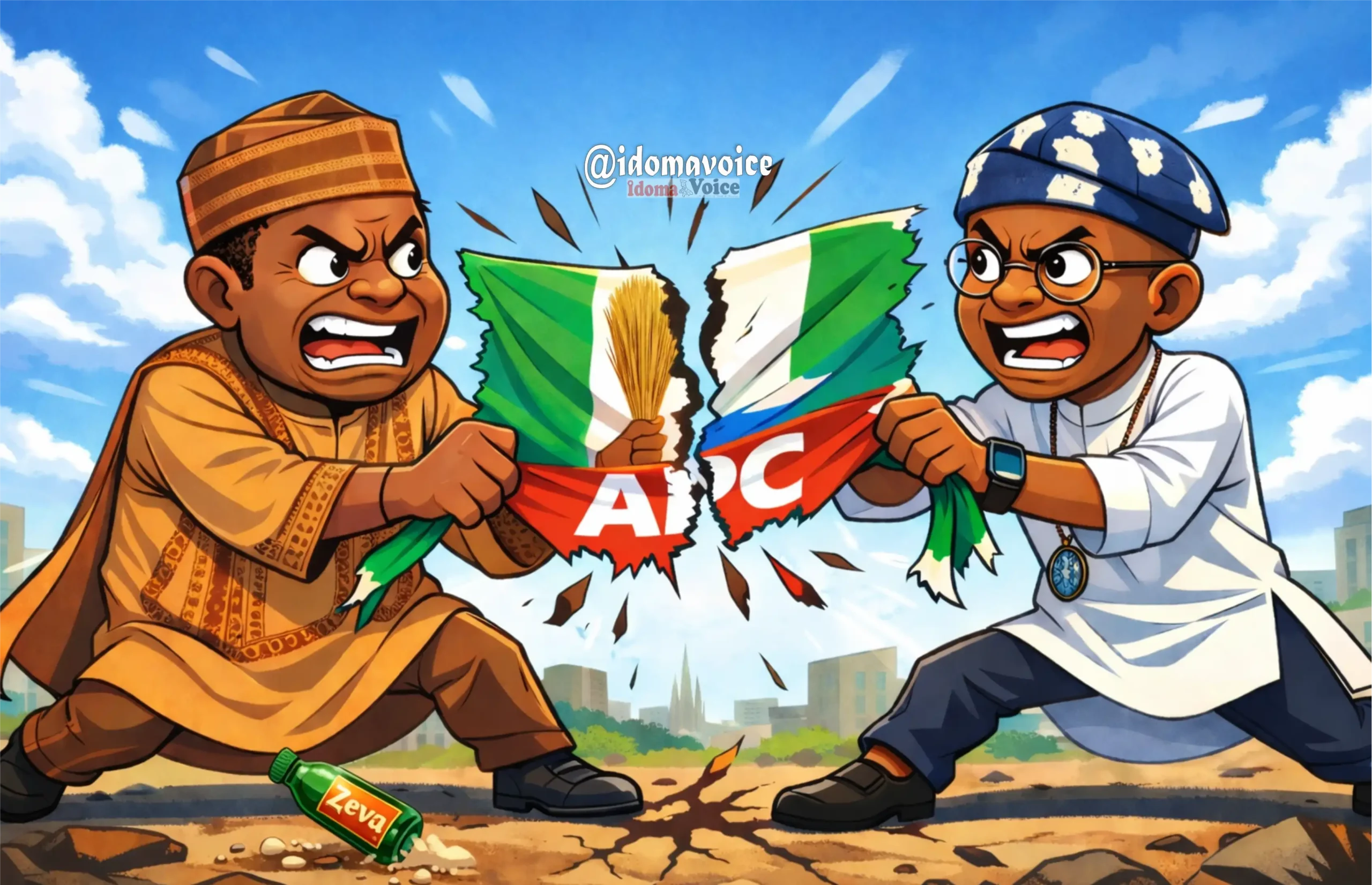
Politics in Benue State has entered what many observers now describe as its most defining internal struggle since the return of democratic governance in 1999, a fierce contest not between opposition parties, but within the ruling All Progressives Congress (APC) itself.
IDOMA VOICE reports that at the centre of the storm stand two powerful brothers: the Executive Governor of Benue State, Rev. Fr. Hyacinth Alia, and the Secretary to the Government of the Federation (SGF), Senator George Akume, two Tiv natives, once allies, now leaders of rival camps fighting for control of the party structure.
What began as quiet disagreements following the 2023 elections has evolved into a full-blown political confrontation threatening to fracture the APC in the state. Recent developments have only deepened the divide.
Fresh turmoil erupted after parallel ward and local government congresses were conducted across Benue’s 276 wards during the week, with rival factions producing competing executives, each claiming legitimacy and recognition.
For many party faithful, the question is no longer whether there is a crisis, but who ultimately controls the political future of Benue.
IDOMA VOICE reports that in April 2024, the Tor Tiv and Chairman of the Tiv Area Traditional Council (TATC), HRM Prof. James Ayatse, successfully brokered a peace deal between Benue State Governor, Rev. Fr. Hyacinth Alia, and Senator George Akume. However, the accord was short-lived, as both leaders soon resumed their struggle for supremacy over the soul of Benue State.
Attempts at reconciliation have reportedly struggled against deep mistrust.
In Nigerian politics, control of party structures is more than ceremonial.
Ward executives determine delegates; delegates determine primaries; primaries determine candidates; and candidates determine power.
Political analysts said the ongoing struggle is fundamentally about positioning ahead of the 2027 general elections. Whoever controls party structures ultimately shapes tomorrow’s ballot.
Governor Alia, riding on a wave of popular grassroots support after his surprise electoral victory, is seen by loyalists as determined to consolidate authority within the state.
On the other hand, Akume, a former governor and one of Benue’s most influential political architects, commands decades of loyal networks stretching across wards, federal institutions and party leadership circles.
The collision between grassroots momentum and entrenched political machinery has turned APC meetings into battlegrounds.
Across several local governments, competing congresses have produced two sets of leaders.
Each faction insists its exercise followed due process while accusing the other of hijacking the party, IDOMA VOICE reports.
Supporters of the governor, led by Ben Omale, have argued that the administration deserves control of the state structure to deliver governance without sabotage.
Akume loyalists, led by Austine Agada, counter that party institutions must not become extensions of Government House.
The result is confusion at the grassroots, with party members unsure which executives to obey and growing fear that litigation may soon replace reconciliation.
The crisis has attracted attention beyond Makurdi. As SGF, Akume occupies one of the most powerful administrative offices in the Federal Government.
Governor Alia, meanwhile, remains the APC’s biggest electoral asset in the state.
A member of the APC in the state, George Jack, has warned that, “Any escalation risks embarrassing the national leadership of the ruling party.”
The camp of Governor Alia received a boost recently following the defection of former Governor Gabriel Suswam to the APC.
Suswam is reported to have assumed the role of a political godfather to Alia after his fallout with Akume.
While APC factions trade accusations, the opposition Peoples Democratic Party (PDP) appears to be quietly watching events unfold.
Political history in Nigeria shows that internal implosions often hand victory to outsiders.
Ochigbo Adakole, a political analysts in Benue South warned that, “A divided ruling party has rarely survived elections unscathed. This prolonged infighting could reopen political space the APC fought hard to close in Benue. In politics, nature abhors a vacuum and where unity collapses, opportunity rises.”
Beyond party structures lies another concern, governance. Benue faces persistent security challenges, economic pressure, and humanitarian crises linked to displacement.
Many citizens fear prolonged political warfare may distract leadership attention from urgent state matters. Markets, farms and communities rarely benefit from prolonged elite battles.
Several scenarios now loom: reconciliation through party elders, intervention from APC national leadership, court battles over legitimacy, or a prolonged cold war stretching toward 2027.
But one reality is already clear: the struggle between Alia and Akume has become more than a disagreement.
It is now a contest for political legacy, and perhaps the most consequential internal fight Benue APC has ever faced.
As the party pulls in opposite directions, one question echoes louder across the state: Will unity prevail before the fabric tears completely apart? Benue people are watching.











War: ‘We did it’ – Iran admits shooting down US aircraft in Iraq
Benue people left me alone at the end of my tenure – Ortom
BREAKING: Four killed after US refuelling plane crashes in Iraq

CBN directs banks to bar loan defaulters from accessing credit facilities

Fear grips Benue South APC as loyalists of Rep Philip Agbese dump party

Benue: Senate calls for military base in Kwande to tackle rising insecurity

Powerful interests working against Tompolo’s war on oil theft – Adeyanju

Abuja fertility case: Defence counsels warn against misrepresentation of facts

10 Things to Know from Nigerian newspapers, Friday, 13th March 2026

Benue Assembly approves second reading of Security Trust Fund Bill

Burial of 13 Benue attack victims postponed as mortuary attendant disappears
