
Nigeria News
Senate passes state police bill

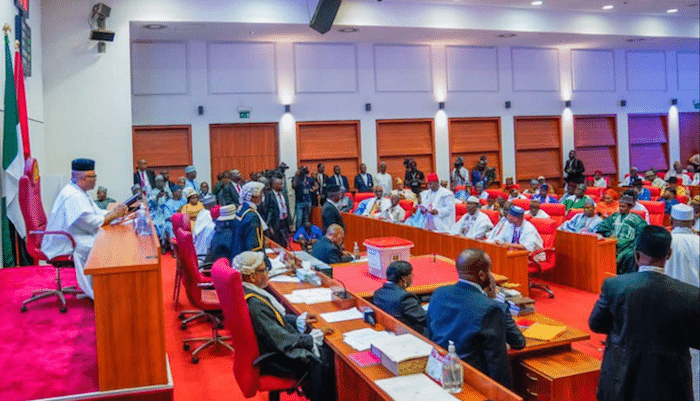
The Senate has passed a constitutional amendment proposal aimed at establishing state police services across Nigeria, marking a major step toward restructuring the country’s security architecture.
The legislation scaled through on Wednesday after senators reviewed and adopted all 26 clauses during the Committee of the Whole session.
The amendment seeks to provide a constitutional basis for state-owned police formations that will operate alongside the existing Nigeria Police Force.
Lawmakers said the move is intended to improve security coordination, enhance intelligence gathering at the grassroots level, and ensure quicker responses to security challenges within communities.
Bamidele Describes Proposal as Historic Reform
Leading the debate, Senate Leader Opeyemi Bamidele explained that the bill was forwarded to the National Assembly by President Bola Tinubu as an executive proposal.
According to him, the legislation ranks among the most important constitutional changes since the country’s return to democratic governance.
“This important Bill is an Executive Bill transmitted by Mr. President and Commander-In-Chief of the Armed Forces of the Federal Republic of Nigeria, seeking to alter the Constitution to provide for the establishment of State Police Services and other related matters,” he said.
“This Bill represents one of the most significant constitutional reforms in our nation’s democratic evolution. It addresses a long-standing national conversation on the structure, effectiveness, responsiveness and sustainability of policing in the Federal Republic of Nigeria.”
Bamidele argued that Nigeria’s centralized policing arrangement is increasingly overstretched by growing and evolving security threats.
“The increasing complexity of security threats, which include terrorism, banditry, kidnapping, communal conflicts, farmer-herder clashes, cybercrime, organised criminal networks and other transnational crimes, have placed enormous pressure on the existing policing framework,” Bamidele said.
He noted that while the federal police would remain in place, the amendment would empower states to establish their own police services through laws enacted by their respective state assemblies and in compliance with standards set by the National Assembly.
Under the proposal, federal authorities would continue to handle terrorism, organized crime, cybercrime, border protection, arms trafficking, policing in the Federal Capital Territory, and other matters of national security.
State police services, on the other hand, would focus on enforcing state laws, maintaining public order, preventing crime, and safeguarding lives and property within their jurisdictions.
Bamidele also highlighted provisions designed to prevent misuse of state police by political office holders. He said governors would be barred from using the force to unlawfully target individuals, political parties, organizations, or associations.
The bill further prohibits the deployment of police powers for partisan, ethnic, religious, sectional, or personal interests.
Abaribe Backs Bill Despite Previous Opposition
Senator Enyinnaya Abaribe of Abia South revealed that he had previously opposed the creation of state police but had reconsidered his stance due to Nigeria’s worsening security situation.
“Mr. President, I used to be one of those that is against state police. Mark my words; I used to be,” he said.
”But today, we know that we have very serious insecurity problem that can only be solved by thinking outside the box. And I think that this is part of it.”
Abaribe, however, stressed that greater attention should be paid to the Police Act that would govern the implementation of the constitutional amendment.
“But our issue on this is actually what goes into the police act. It’s not really the amendment of the constitution. Because you can amend the constitution but then in the act, matters of usage of the police is where most Nigerians are bothered about,” he said.
He warned against provisions that could allow excessive federal control over state police formations.
“We cannot have a situation where the president just looks at a state, maybe he’s not in good terms with the governor, and decides that he will take it over,” he said.
The senator also advocated constitutional guarantees for funding state police commissions, arguing that allocations should go directly to them to avoid political interference.
“So that what we are seeing today, with regard to local government funds, we don’t have to see it with the police,” he said.
“I support this bill and I ask my colleagues to please also support it, provided we put the safeguards that we guarantee each Nigerian his rights.”
Tambuwal Says State Police Will Deepen Federalism
Senator Aminu Tambuwal of Sokoto South expressed strong support for the bill, stating that he has consistently advocated state policing as a means of strengthening Nigeria’s federal structure.
“Mr. President, let me make it clear that I am in support of this bill and I am in support of the idea of state police,” he said.
“I have been consistent on this, not only when I was in the House of Reps as Speaker and as Governor of Sokoto State, even while here in the Senate, in the number of interviews I granted, I alluded to the fact that I support state police because I believe that that will also be a major leap into entrenchment of federalism in Nigeria.”
Tambuwal pointed to repeated attacks in Sokoto State as evidence that alternative approaches to policing are urgently required.
“Only about three or four years ago, in my senatorial district, we lost over 80 people in Dange Shuni local government. Only three or four days ago, in the same local government, we lost some personnel of police that were there on rescue mission to send away bandits,” he said.
“So that is a clear picture of what is happening in most parts of the country. This is needed. Every effort, any effort to curb this menace of insecurity in Nigeria is needed.”
Like Abaribe, Tambuwal emphasized the importance of safeguards to prevent abuse of state police powers by political leaders.
“We must have safeguards that will now ensure that there is no abuse on the part of those who are today in that position that we have left. And those who are coming, even those from amongst us, to this position of being governors of particular states,” he said.
The former governor urged lawmakers to support measures aimed at improving security nationwide.
“I believe that the Senate of this country, we must ensure that we support Mr. President, support the security agencies in every effort that will establish security in every part of this country,” he said.
For the constitutional amendment to become law, it must still receive endorsement from at least two-thirds of Nigeria’sstate houses of assembly before being forwarded to President Tinubu for assent.



‘Let us heal, unite’ — Adeleke appeals to Osun residents

2027: Ideyi emerges ADC candidate for Ebonyi South senate seat

Ogbadibo at 35: Ogbeh, Doni Roberts, others for posthumous honours

‘Atiku is confused’ — Wike reacts to fuel subsidy promise

FG won’t pursue death penalty appeal against Nnamdi Kanu — Ejimakor

2027: Police warn Katsina politicians against recruiting youths for political thuggery

NAPTIP arrests three, seals maternity facility over baby trafficking in Rivers

Ogun Gov Abiodun welcomes PDP, ADC ward leaders into APC

Living Christ Mission founder Daddy Hezekiah accused of sexual abuse

24 bandits killed as security forces foil mass kidnap attempt in Katsina

2027 elections: INEC has no preferred candidate, vows neutrality – Amupitan
