
idoma news
Och’Idoma’s Gesture to Kumuyi: Much Ado About Nothing

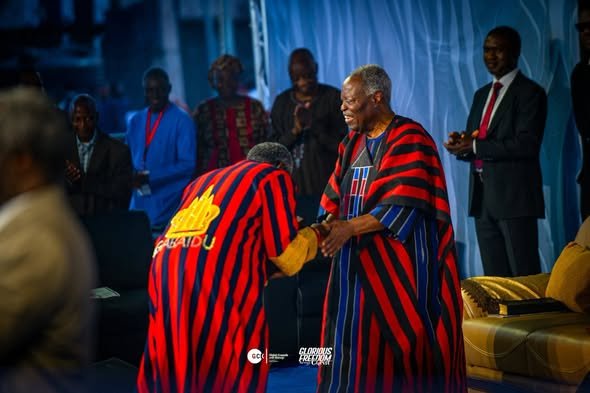
A single photograph has stirred an unnecessary debate across Idoma land.
The image, showing the Och’Idoma, His Royal Majesty Dr. John Elaigwu Odogbo (Agaba Idu), bending in greeting to the General Superintendent of the Deeper Christian Life Ministry, Pastor William Folorunso Kumuyi, has generated heated reactions on social media. Some critics have described the gesture as unbecoming of the paramount ruler of the Idoma people, arguing that a king should never bow before an ordinary man.
We respectfully disagree.
Leadership, whether traditional, political or religious, is not diminished by humility. If anything, history teaches the exact opposite.
Throughout the Bible, some of God’s greatest leaders demonstrated humility without surrendering their authority. King David, one of Israel’s greatest monarchs, danced before the Ark of the Covenant in an act of reverence before God. King Solomon, despite his immense wealth and royal status, acknowledged wisdom wherever he found it and welcomed prophets and elders with honour.
The Scriptures also repeatedly emphasise humility. Proverbs 22:4 declares, “Humility is the fear of the Lord.” James 4:10 urges believers to “Humble yourselves before the Lord, and He will lift you up.”
Even Jesus Christ, whom Christians regard as King of kings, washed the feet of His disciples to teach that true greatness is expressed through service, not pride.
The Och’Idoma’s gesture was not an act of worship. Neither was it a surrender of the dignity of the Idoma throne. It was a courteous expression of respect during a Christian gathering attended by thousands of worshippers.
Those who have followed Pastor Kumuyi’s ministry know that he is one of Nigeria’s most respected Christian leaders, with decades of influence extending across Africa and beyond. Extending respect to such a figure does not reduce the stature of a traditional ruler.
History equally provides numerous examples.
Across Africa, traditional rulers have bowed, knelt or exchanged gestures of respect with presidents, religious leaders and fellow monarchs depending on the occasion and cultural expectations.
In the United Kingdom, members of the Royal Family bow to the monarch, while the monarch, in turn, has demonstrated humility before religious leaders and during solemn national ceremonies.
In Japan and other parts of Asia, even emperors bow as a mark of courtesy. Such gestures are understood as expressions of civility rather than inferiority.
The Idoma institution has always been one of dignity, wisdom and diplomacy. Strength has never been measured by an unwillingness to show respect.
Indeed, one of the greatest qualities of a traditional ruler is the ability to unite people across religious, political and cultural divides.
Unfortunately, social media often encourages instant outrage without reflection. A single frozen image rarely tells the full story of an event. Before passing judgement, critics should ask themselves whether the photograph captured a formal act of homage or simply a respectful greeting between two elderly leaders.
The danger in magnifying such issues is that they distract attention from matters that truly deserve public concern: the security of our communities, the welfare of our people, economic opportunities for our youth and the preservation of our cultural heritage.
The Och’Idoma remains the custodian of the customs, traditions and collective identity of the Idoma nation. That status cannot be diminished by a courteous gesture extended to a respected cleric.
If anything, humility has long been recognised as one of the defining qualities of great leadership.
Perhaps the lesson from this episode is not that our royal father bowed too low, but that public discourse has, at times, sunk too low.
The Idoma nation should spend less time debating a gesture of courtesy and more time supporting the institutions and leaders working to promote unity, peace and progress among our people.



‘I sold my car to promote leadership values’ — Author Stephen Elaigwu

13-year-old boy allegedly sets family house ablaze, kills four sisters in Yobe

$100,000 too small — Lagos Life creator values viral game at $1bn

Man sentenced to death over facebook comment Saudi Arabia

Eight Nigerian soldiers killed in ISWAP attack on Borno military base

BREAKING: NAF helicopter makes emergency landing in Benue two days after Ondo crash

Deji Adeyanju celebrates Abulfatai Seriki at 53, hails contributions to Nigeria

Fact-checking Benson Abounu: Did Enone hold Benue South Senate seat for 25 Years?

The Royalties: Why we’re building 20-storey luxury apartment in Abuja — Peter Adejoh

Benson Abounu tackles David Mark over 20-year Senate tenure

The Royalties: Peter Adejoh, partners set to build 20-storey luxury apartment in Abuja
