
idoma news
BURIED TOO SOON? Outrage in Benue as 15-year-old orphaned girl dies after alleged abuse

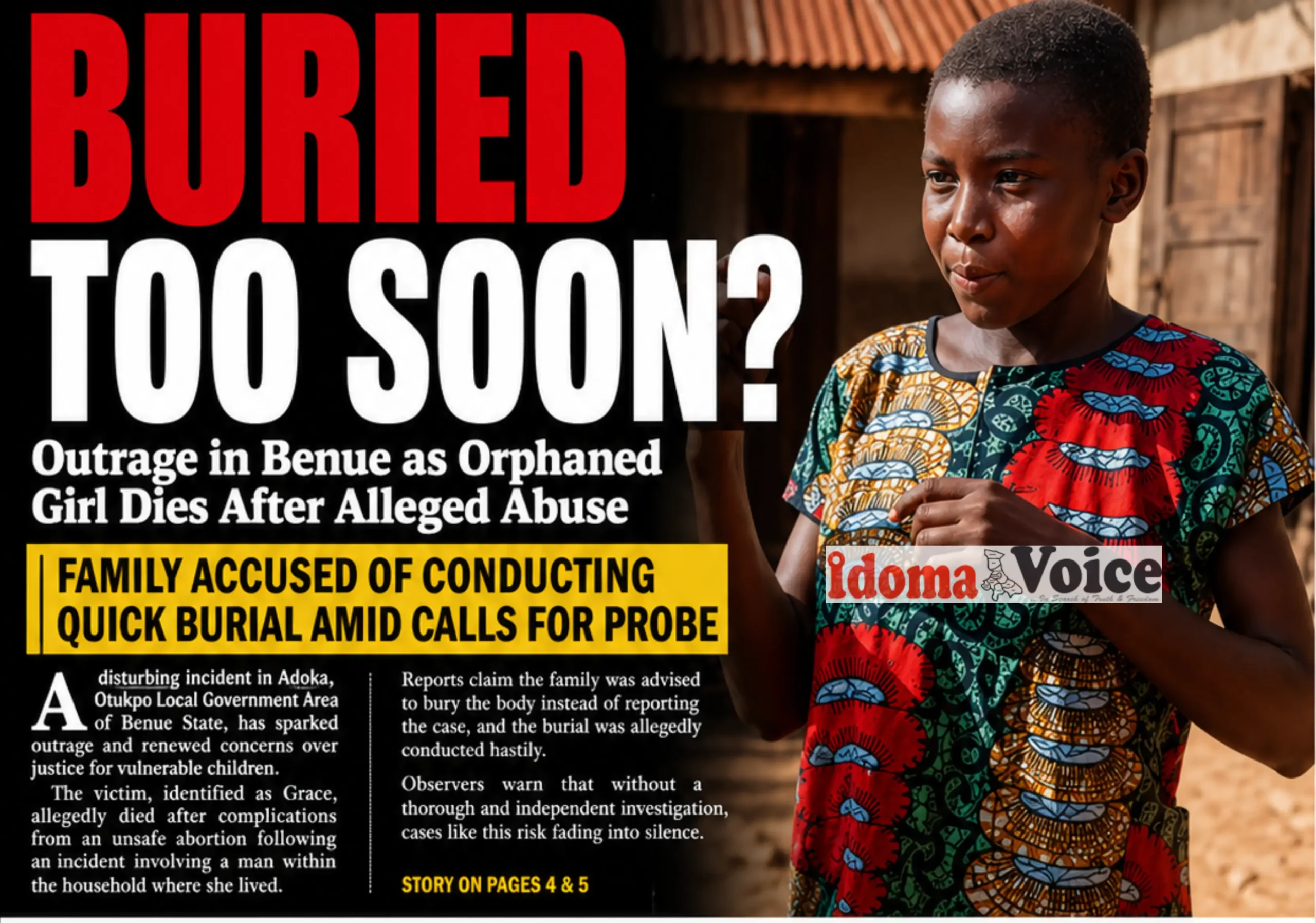
A disturbing incident in Adoka, Otukpo Local Government Area of Benue State, has sparked outrage and renewed concerns over justice for vulnerable children, following the death of a 15-year-old orphan under troubling circumstances.
IDOMA VOICE reports that the case, which echoes the widely reported Ochanya Ogbanje tragedy, was brought to public attention by activist and citizen journalist, Meddy Olotu.
“For those who know about the Ochanya story, another one happened a few days ago in Adoka, Otukpo Local Government Area of Benue State,” Olotu said.
The victim, identified as Grace, had lost both parents and was reportedly living with relatives at the time of the incident.
“This young girl had no mother and no father. Both parents are dead, so she was given to relatives… The girl had nowhere to go,” Olotu stated.
According to the account, Grace allegedly became pregnant after an incident involving a man within the household where she resided. She was reportedly taken for an abortion under unsafe conditions, leading to severe complications.
“The man took the girl to abort the pregnancy, and she suffered severely, bleeding and complications, until she died,” Olotu alleged.
Before her death, the teenager was said to have disclosed details of her ordeal.
“Before the girl died, she spoke about what happened to her, but she was warned not to talk,” he added.
Following her death, the suspect reportedly fled the community, while her body was returned to the family.
“After her death, they brought her body back and the man ran away,” Olotu said.
However, what has generated the most concern is the reported handling of the case at the community level. There are allegations that instead of reporting the matter to law enforcement authorities, the family was advised to hurriedly proceed with burial.
“The chief told the family to bury the body instead of reporting the case,” Olotu claimed.
Legal and medical experts noted that in cases involving suspicious deaths, especially of minors, standard procedure requires immediate police involvement, preservation of evidence and a post-mortem examination.
“The body should have been taken to the mortuary for autopsy so we can get to the root of the matter,” Olotu insisted.
Reports that the burial was conducted swiftly have raised fears that crucial evidence may have been lost.
“As I speak, the girl has already been buried. What evidence do we have to work with now?” he queried.
There are also claims that the alleged perpetrator is known within the community, yet no public action has been taken.
“They said they would find the person responsible, but days are passing and nothing has been done… This matter is already being swept under the carpet,” Olotu alleged.
With no parents to advocate for her and relatives reportedly afraid to speak out, concerns are growing that the case may not receive the attention it deserves.
“The girl who should speak is no longer alive. Her parents are not alive. The relatives are afraid to speak,” he said.
Olotu also questioned the response of community leadership, urging accountability.
“If it were your child or your relative, how would you handle this? Why is the chief not bringing this person out? It’s quite sad,” he added.
Amid mounting outrage, several stakeholders have called for the immediate exhumation of the girl’s body to allow for a proper autopsy and forensic investigation.
A legal practitioner, Barr. Samuel Ochai, said the case cannot be allowed to end without scientific verification of the cause of death.
“The body should be exhumed immediately and subjected to a proper autopsy. That is the only way to establish the true cause of death and ensure justice is not denied,” he said.
Also speaking, child rights advocate, Mrs. Linda Grace Ene, described the reported burial as premature and troubling.
“A rushed burial in a case like this raises serious concerns. Authorities must order an exhumation so that forensic experts can determine what really happened,” she stated.
For community youth leader, Comrade Peter Okopi, justice for the deceased must begin with uncovering the truth.
“If we are serious about justice, the girl’s body must be exhumed. Evidence may still be recoverable, and that process should not be delayed any further,” he said.
Similarly, a civil society representative, Grace Ikwu, stressed that the case must not be closed without due process.
“This case cannot end with a quiet burial. The body should be exhumed, investigated properly, and those responsible held accountable,” she added.
The incident draws painful parallels with the widely reported case of Ochanya Ogbanje, another young Idoma girl whose death exposed deep failures in protection and accountability.
The current incident has revived memories of the 2018 case of Ochanya Ogbanje, a 13-year-old girl from Benue State whose death sparked nationwide outrage and demands for justice.
Ochanya was reportedly subjected to prolonged sexual abuse by a man she lived with, identified in reports as her guardian. The abuse, said to have lasted for months, left her with severe physical and medical complications, including infections and internal injuries.
She was eventually taken to the hospital, where she died in October 2018.
Her death triggered widespread condemnation across Nigeria, drawing attention to the vulnerability of children in domestic settings and failures in community protection systems. Civil society groups, religious bodies, and citizens demanded accountability, with protests and sustained media coverage amplifying calls for justice.
Authorities arrested suspects in connection with the case, and legal proceedings followed. The case moved through the courts, attracting national attention.
However, despite the initial public outcry, interest gradually waned over time. While prosecutions were initiated, concerns were repeatedly raised about delays in the judicial process and whether justice was being pursued with the urgency the case demanded.
Years later, the Ochanya case remains a reference point in conversations around child abuse and justice in Nigeria—often cited as an example of how high-profile cases can generate intense public reaction, yet struggle to sustain momentum toward timely and conclusive justice.



20-year-old man stabbed to death after argument with teenager in Cross River

EPL transfers: Liverpool, Chelsea, Man City lead summer spending as deadline day arrives

EPL matchweek 2: Man Utd bounce back as Arsenal, Chelsea maintain perfect starts

Court cancels APC Zamfara North senatorial primary, gives party 14 days for fresh election

Mass exodus hits Benue South APC as ex-LG boss, Alia loyalists dump party for NDC over Onjeh

EFCC declares ex-Gov Timipre Sylva wanted again over alleged $14.86m fraud

Bandits kill APC ward leader, resident in Kano

10 abducted NYSC members rescued from Kogi forest

Breaking: Lionel Messi retires from international football at 39

BREAKING: NNPCL raises petrol price by N75 to N1,345 per litre

‘The Tiv are not our problem, we are’ — David Onoja speaks on Idoma marginalisation, Alia, 2027 race
