
idoma news
OTUKPO WEEPS: Tears, anger as 16 Ugboju attack victims are laid to rest

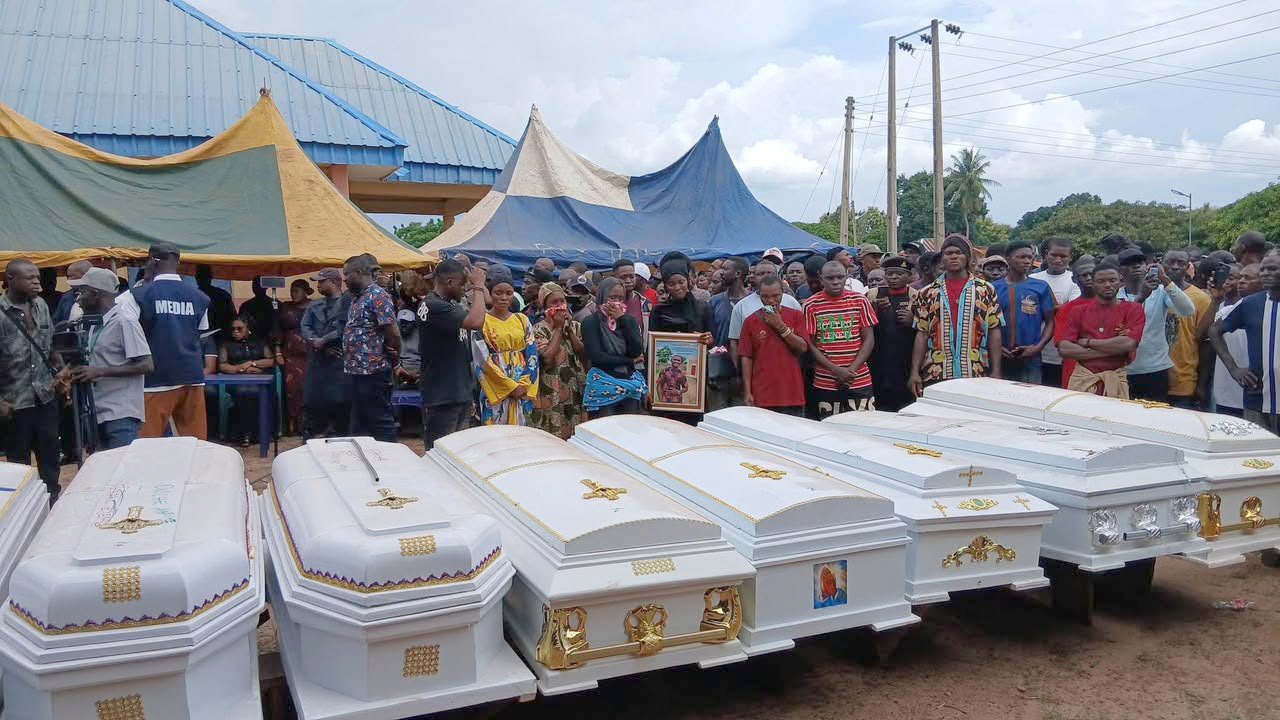
Saturday was a day of grief for the Idoma nation. In Efeyi community, Ugboju District of Otukpo Local Government Area of Benue State, families gathered around coffins containing the remains of 16 of their loved ones.
Thousands of kilometres away in London, United Kingdom, Idoma sons and daughters gathered for the First Annual Convention of the Idoma Association, United Kingdom.
The two gatherings were different in purpose and atmosphere, but they were connected by one painful subject—the worsening insecurity in Idoma land.
While tears flowed in Efeyi as 16 victims of a suspected armed herdsmen attack were committed to the earth, the Och’Idoma, His Royal Majesty, Agaba-Idu Elaigwu Odogbo Obagaji John, was telling his people in London that Idoma Kingdom would never be conquered.
At the same gathering, Senate Minority Leader and Senator representing Benue South, Abba Moro, captured the condition of the homeland in a haunting description.
“Idoma land is a wounded traveller,” he declared.
For the people of Efeyi, Saturday’s tragedy had begun almost two weeks earlier.
The victims were killed when suspected armed herdsmen invaded the community in the early hours of July 28.
Residents said the attackers stormed Efeyi between 4am and 5am, opened fire and killed 16 persons, sending terrified residents fleeing for safety.
On Saturday, the dead finally returned to the earth.
Family members, community leaders, traditional rulers, political leaders and religious figures gathered as the community conducted a mass burial for the victims.
It was a scene of anguish.
As the coffins were brought to the burial ground, bereaved relatives and sympathisers struggled to contain their emotions. A Catholic priest led prayers for the repose of the souls of the deceased before the coffins were lowered into the graves amid wailing.
For a community already living with the trauma of attacks, it was another reminder of the human cost of insecurity.
Aboyi Owi, a resident who witnessed the burial, described it as one of the saddest moments in the history of Efeyi.
“The funeral was so touching. The atmosphere is full of sorrow, tears and anger because this was an avoidable death if those responsible for ensuring the security of lives and property were alive to their responsibilities,” he said.
Owi’s grief quickly turned into anger.
“We do not know when our government will take genuine action to end the activities of armed herdsmen in this country. For as long as we allow armed herders to keep tormenting Nigerians, there will be no end to the mass killing of Nigerians by the criminal gangs.
“This is just the saddest day for the people of Efeyi community,” he added.
From Efeyi to London
But the anguish over what is happening in Idoma land did not remain within the boundaries of Otukpo.
On the same Saturday, the security crisis followed the Idoma people all the way to London.
At the First Annual Convention of the Idoma Association, United Kingdom, the Och’Idoma addressed members of the Idoma diaspora against the backdrop of the killings and displacement confronting communities back home.
His message was defiant.
The Idoma Kingdom, he declared, would not be conquered by armed herdsmen.
For a people who had just watched another 16 of their sons and daughters lowered into graves in Efeyi, the words carried a deeper significance.
The monarch’s declaration was not merely about the security situation. It was also a message about the survival of a people on their ancestral land.
Communities have come under attack. Farmers have been forced from their farms. Families have been displaced. Lives have been lost.
Yet the Och’Idoma’s message from London was that Idoma land would not surrender.
‘Idoma land is a wounded traveller’
If the Och’Idoma’s message was one of defiance, Senator Abba Moro’s was a sober description of the wounds the attacks have inflicted on the people.
Addressing the convention, Moro said the celebration of Idoma identity in the diaspora could not be separated from the painful reality confronting those at home.
“Idoma land is a wounded traveller,” the senator declared.
Moro said Idoma land was passing through one of the most difficult periods in its history.
“We have buried innocent fathers and mothers, young men and women, and children whose lives were tragically cut short by marauding herders’ elements. Families have been displaced. Farmers have abandoned their ancestral lands. Many of our communities continue to live under the shadow of uncertainty/insecurity,” he said.
Those words assumed an almost literal meaning on Saturday.
Back home in Efeyi, another set of families was doing exactly what Moro was describing in London—burying victims of violence.
Sixteen of them.
Moro told the gathering that, as Senator representing Benue South and Senate Minority Leader, he had repeatedly raised the security concerns of his constituents on the floor of the Senate.
He said he had advocated stronger federal intervention, improved security architecture and greater protection for communities.
But the senator also acknowledged that the responsibility for securing Idoma land could not rest on rhetoric.
While government bears the constitutional responsibility to safeguard lives and property, he said lasting peace would also require vigilance, cooperation and the collective commitment of the people.
A homeland under pressure
The Efeyi burial and the speeches in London told essentially the same story from different locations.
One showed the consequences of insecurity.
The others articulated the fear, anger and determination it has produced.
In Efeyi were the coffins.
In London were the voices warning about what those coffins represented.
The concern is increasingly not merely about individual attacks but about what persistent violence means for farming communities whose residents are being forced away from their ancestral lands.
For communities that depend heavily on agriculture, abandoning farmland does more than deprive individual families of their livelihoods. It disrupts communities and raises deeper questions about whether displaced residents will be able to return safely to the lands they inherited from generations before them.
That was the concern behind Moro’s reference to farmers abandoning their ancestral lands and communities living under uncertainty.
It also gave context to the Och’Idoma’s declaration that the Idoma Kingdom would never be conquered.
Between grief and defiance
Saturday therefore presented two powerful images of the Idoma condition.
The first was in Efeyi.
There, families stood helplessly as 16 coffins disappeared beneath the earth.
The second was in London.
There, the paramount ruler of the Idoma people and the senator representing Benue South spoke before an Idoma diaspora thousands of kilometres from home about the security of the land they had left behind.
One gathering mourned the dead.
The other contemplated the future.
Yet both were bound by the same question: How much longer will Idoma communities continue to bury victims of attacks?
For Moro, the homeland is wounded.
For the Och’Idoma, however, being wounded does not mean being defeated.
And perhaps those two statements best captured the mood of Saturday.
Idoma land may indeed be a wounded traveller, carrying the scars of killings, displacement and abandoned farmlands.
But as 16 fresh graves in Efeyi became another painful addition to those scars, the message from the Idoma throne in London was equally unmistakable:





All Set for ProTaxi Launch October 1 at Rainbow Event Center, Abuja

BREAKING: Police arraign alleged fake agency DG, Adeniyi Adeyemi

‘I am here, more than ever’ — Guardiola sends message to Man City fans

Nigerians must be free to criticise govt policies if they hurt them — Atiku

Nigeria at 66: FG declares october 1 public holiday

Drama as staff, students rally over police attempt to arrest FUOYE VC

Two pilots injured after reported fight on Dubai-Tel Aviv Flight

Zamfara security: Army activates three new infantry battalions

Peter Obi lied recklessly over sports investment — Onanuga

As long as one Nigerian lives in IDP Camp, we are all displaced — Obi

50-year-old man sentenced to 10 years in prison for raping 11-year-old in Jigawa
