
Benue news
One year after Yelwata massacre: The wounds refuse to heal


By Ameh Godwin & Abah Rapheal and Agbenue James
One year ago today, Yelwata stood still.
What was once a bustling farming community on the Makurdi-Abuja highway became the scene of one of the deadliest massacres in Benue State’s history.
IDOMA VOICE recalls that in a single night of horror, hundreds of men, women and children were slaughtered, burnt alive in market stores, churches and shelters where they had sought refuge from an attack many residents had feared was coming.
Twelve months later, the smoke has disappeared from the ruins, but the pain remains.
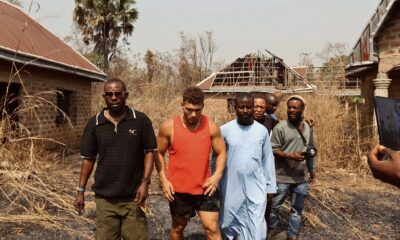
The scars of June 13 and 14, 2025, are still visible across the community. Burnt buildings remain standing as grim reminders of the carnage.
Roofless homes and blackened walls continue to line parts of the town. Families who lost loved ones still struggle to rebuild their lives, while many survivors remain displaced, traumatized and uncertain about the future.
For Yelwata, time has moved forward. Healing has not. Residents remember the night with painful clarity.
Gunfire shattered the silence as suspected armed herdsmen descended on the community. Homes, market stores and shelters housing displaced persons were set ablaze. Those who fled were hunted down. Others were trapped in burning buildings.
By morning, entire families had been wiped out.
Among the victims was Pharmacist Matthew Iormba, a brilliant young graduate who had returned home after completing his housemanship. There was also young Lucy Tsegba, who lost her mother and five siblings in the inferno.
Countless other victims never made the headlines.
Many died anonymously in the flames that engulfed market stores where villagers had gathered to sleep for safety. Some bodies were burnt beyond recognition. Others were never properly identified. The exact death toll remains disputed.
While official figures released by the Benue State Government placed the number of deaths at 59, survivors, community leaders and independent observers insist that well over 300 people were killed. For residents of Yelwata, the argument over numbers has become another source of pain.
To them, the tragedy cannot be measured by statistics. It is measured by empty compounds, abandoned farms, orphaned children and families whose bloodlines were erased in a single night. Before the attack, Yelwata was known for its vibrant agricultural economy.
The community served as a major commercial hub where farmers sold yam, maize, rice, soybeans and other produce. Traders moved freely between Benue, Nasarawa and Abuja. Markets bustled with activity.
Today, much of that energy is gone. Many families who fled have never returned. Businesses that once sustained households remain shut. Several buildings destroyed during the attack have not been rebuilt. Walking through parts of the community today is a painful reminder of what happened. Charred walls still stand. Collapsed structures remain untouched.
The ruins have become monuments of grief.
Residents say fear continues to shape everyday life. Many still avoid sleeping in isolated locations. Others remain haunted by memories of that night.
The attack did not simply destroy buildings. It shattered a way of life.
In the months following the massacre, efforts were made by individuals and humanitarian groups to help survivors rebuild.
One of the most notable interventions came from Christian missionary Alex Bardir, who mobilized resources to reconstruct some of the destroyed homes and assist affected families.
For many survivors, his intervention represented one of the few tangible signs of hope.
However, community members say broader reconstruction efforts never gained the momentum required to restore the town.
Residents have repeatedly complained that bureaucratic obstacles and official frustrations slowed private rebuilding initiatives that could have accelerated recovery.
As a result, many victims remain without adequate housing one year later.
Several families continue to rely on temporary arrangements while awaiting meaningful support.
The handling of the Yelewata tragedy continues to generate debate.
Critics point to the delayed response following the massacre, the controversy surrounding casualty figures and the absence of comprehensive reconstruction efforts.
Many residents argue that beyond condolences and official visits, little has changed on the ground.
The most visible government intervention remains the monument erected in memory of the victims.
While many acknowledge the symbolic importance of honouring those who died, survivors insist that remembrance alone cannot address the realities confronting affected families.
A monument cannot rebuild a home.
A monument cannot replace a father, mother or child.
A monument cannot restore livelihoods lost in a single night.
For many in Yelewata, justice, security and reconstruction remain the true tests of government commitment.
One year later, several questions continue to haunt survivors.
Who planned the attack?
Who carried it out? Why were warnings allegedly ignored? Why have so few answers emerged despite the scale of the tragedy?
For many families, accountability remains elusive. The demand for justice has not faded with time.
Neither has the grief.
Anniversaries often invite reflection.
For Yelwata, this anniversary is not merely a date on the calendar.
It is a reminder of lives interrupted, dreams destroyed and a community still searching for closure.
The names of those who died continue to echo across the town. Their absence is felt in homes, churches, schools and farms.
Children who lost parents are growing up without them.
Parents who buried children carry wounds that no passage of time can erase.
Widows and widowers continue to navigate a future they never imagined.
As Benue remembers the victims of the Yelewata massacre today, the challenge extends beyond memorial ceremonies and public statements.
The real tribute lies in ensuring that survivors are not forgotten.
It lies in rebuilding what was destroyed.
It lies in delivering justice.
And it lies in guaranteeing that no community in Benue State will ever again experience a night like June 13, 2025.
One year later, Yelewata still waits.
The fires may have gone out.
But the wounds remain open.











news12 hours ago
Instagram is for girls – Elon Musk again

news12 hours ago
Sowore challenges DSS DG to honour subpoena, appear in court

news12 hours ago
Oyo govt condemns abduction of corps members, seeks safe release

Education15 hours ago
WAEC appoints Amos Dangut as registrar, CEO
Entertainment15 hours ago
PHOTOS: Joke Silva, sons, dignitaries attend Olu Jacobs’ funeral mass

news15 hours ago
How I killed my girlfriend after HIV dispute — Suspect

news15 hours ago
66th Independence: Tinubu worsened Nigeria’s condition to stage four cancer — Momodu

news16 hours ago
2027: Tinubu unpopular but may win re-election — Economist

news16 hours ago
2027: ACF calls for responsible voting, warns against political violence

news18 hours ago
Woman appeals for rescue of daughter, 18 other abducted NYSC members

Sport19 hours ago
After over 20 years, Messi set for Argentina farewell appearance on Sunday

Benue news2 days ago