
Benue news
Alia under fire over blockade of Peter Obi in Benue as Amnesty, CSOs demand probe

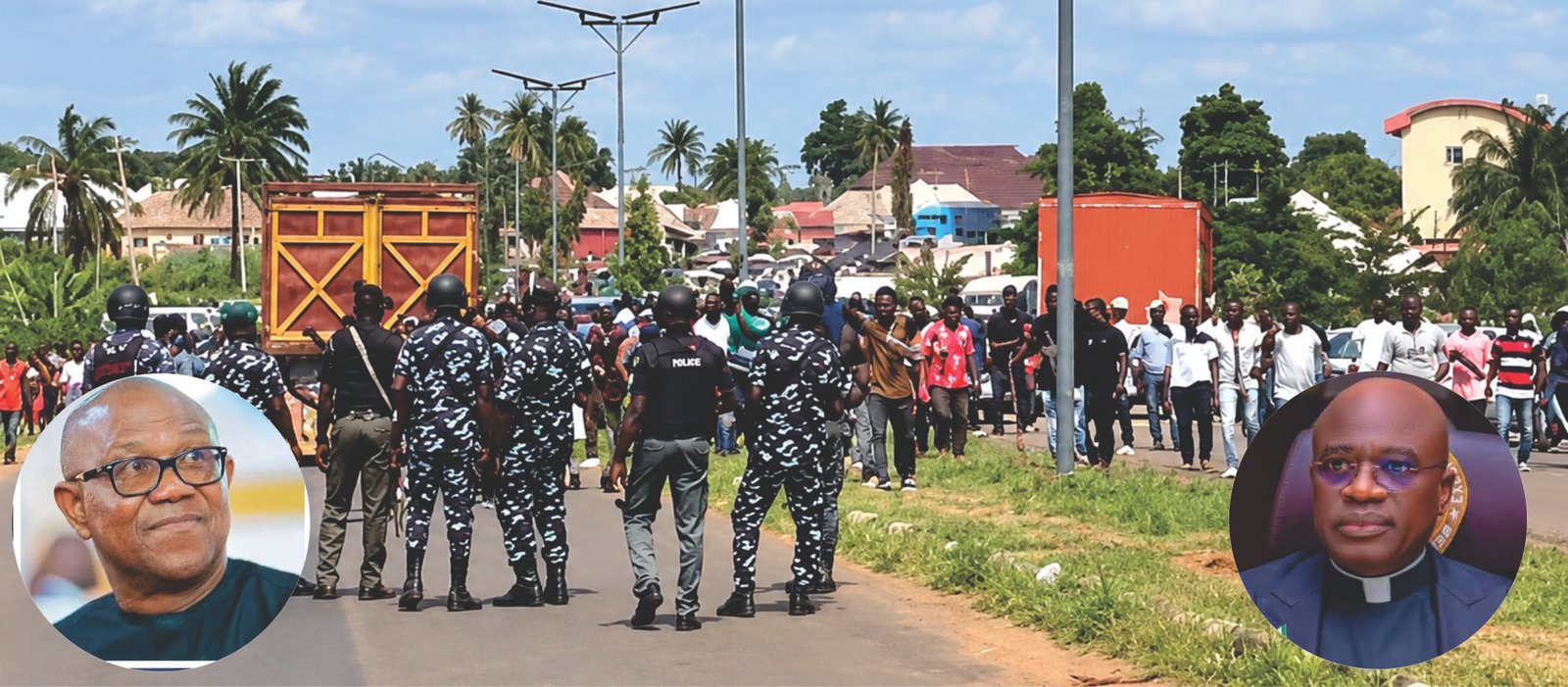
The disruption of the planned visit of the Nigeria Democratic Congress (NDC) presidential candidate, Peter Obi, to Yelwata in Benue State has triggered a fresh political controversy, with Amnesty International, civil society groups and opposition politicians demanding an investigation into the incident, IDOMA VOICE reports.
Obi was in Benue State on Tuesday, September 8, 2026, for what his party described as a humanitarian visit to families affected by the June 2025 Yelwata massacre.
However, his convoy was stopped along the Gboko Road axis of Makurdi by a large group of youths who reportedly barricaded the road and chanted, “Peter Obi, go back.”
Reports from the scene indicated that some of the protesters carried sticks, while stones were allegedly thrown at the convoy. Obi eventually turned back and left the state after he was unable to proceed to Yelwata.
The incident has since generated conflicting accounts over who organised the protesters, whether the Benue State Government knew about Obi’s visit and whether adequate security arrangements had been made for the former Anambra State governor.
Why Obi went to Yelwata
Obi said he travelled to Benue to sympathise with families affected by the killings in Yelwata, where more than 270 people were reportedly killed in June 2025.
The NDC maintained that the visit was not a campaign rally but an opportunity for Obi to mourn with victims, listen to affected families and discuss ways of preventing a recurrence of the attacks.
“I came to Benue not for politics but to mourn with our people, to listen to families who have lost loved ones, and to offer our solidarity during a moment of unimaginable pain,” Obi said.
He described the obstruction as “worrisome” and appealed to the Inspector-General of Police and other security agencies to intervene.
Obi also said he refused to force his way through the crowd because doing so could have created further tension and endangered lives.
‘He never informed us’ — Benue Govt
The Benue State Government has rejected allegations that Governor Hyacinth Alia or his officials sponsored the blockade.
The government, through the Governor’s Chief Press Secretary, Tersoo Kula, said it was not aware that Obi was coming to the state.
According to the government, a high-profile political figure visiting Benue would ordinarily be expected to inform the relevant authorities so that appropriate security arrangements could be made.
The government also questioned the circumstances surrounding Obi’s visit and suggested that the incident could have arisen from internal political disagreements within the NDC rather than any action by the state government.
It insisted that Alia’s administration does not “engage, patronize, or deploy thugs as instruments of governance or security”, stressing that the governor relies on recognised security agencies to maintain law and order.
But police say they knew of Obi’s movement
The government’s claim that it was unaware of the visit has become one of the major points of controversy.
The Benue State Police Command confirmed that it knew Obi was coming to Yelwata and had deployed personnel to provide security for his movement.
Benue Commissioner of Police, Cletus Nwadiogbu, said police were informed that Obi’s visit was not for political campaigning but to visit communities affected by the 2025 attack.
He said the Assistant Commissioner of Police in charge of Operations was directed to personally lead the security team.
According to the police commissioner, the command was later informed that youths had blocked the road and were refusing to allow Obi to proceed.
He said the police were investigating the circumstances behind the blockade and would determine why the youths decided to stop the presidential candidate.
The apparent difference between the positions of the state government and the police has therefore intensified questions about how much government officials knew about the visit before Obi arrived.
A notification letter adds another dimension
A copy of a letter dated September 7, 2026, seen by this newspaper, shows that the Benue State chapter of the NDC notified the Commissioner of Police, Benue State Command, of Obi’s planned visit.
The letter, signed by the party’s State Chairman, Mr Ohini Ojiegbe, stated that Obi was expected to arrive in Makurdi at about 8am on Tuesday before proceeding to Yelwata.
It stated that the purpose of the visit was to meet family members and representatives of the community affected by the 2025 massacre, visit the memorial site, pay respects to the victims and lay a wreath in their honour.
The letter also requested security cover for Obi and his entourage.
Importantly, the document bears a “RECEIVED” stamp from the Commissioner of Police, Benue State Command, dated September 7.
The document could not, by itself, establish whether the information was formally transmitted to the Benue State Government or whether all relevant security and administrative protocols were completed. But it contrasts with the state government’s assertion that it had no knowledge of Obi’s coming.
Amnesty International weighs in
Amnesty International has condemned the incident, describing it as a serious threat to democratic participation and freedom of movement.
The rights organisation said the incident raised questions for the Benue State Government, arguing that Nigerians should not need permission to visit parts of their own country.
Amnesty described the reported blockade as an “unprecedented and dangerous act of political hooliganism” capable of undermining the democratic process.
It also warned against the use of armed vigilante groups or political thugs to intimidate opposition politicians.
The organisation called for authorities to investigate the incident and ensure that those responsible are held accountable.
NDC demands investigation
The NDC has also called for an immediate investigation by the Benue State Government and security agencies.
The party’s National Publicity Secretary, Osa Director, described the obstruction as disturbing and condemnable, insisting that Obi’s mission was humanitarian.
The party said those responsible should be identified and prosecuted and called for guarantees that political candidates and ordinary citizens would be able to travel and engage with communities without intimidation.
“We call on the Benue State Government and relevant security agencies to immediately investigate this incident, bring the perpetrators to justice, and guarantee the safety of all citizens and leaders who seek to show solidarity in times of grief,” the party said.
Yelwata native apologises to Obi
The controversy has also drawn a reaction from a native of Yelwata, Franc Utoo, who apologised to Obi and Nigerians over what he described as “undiluted brigandage” in Benue.
Utoo, a lawyer who identified himself as a native of Yelwata, said the development had further hurt victims of the 2025 killings.
He described the incident as a “rape of the democratic values” of freedom of movement and assembly and accused the Alia administration of failing to adequately address the concerns of victims since the massacre.
“In our modesty, we apologise for all the malfeasance emanating out of Benue today just because a candidate was coming to visit our terribly traumatised people,” he said.
Keyamo raises media double-standard argument
Minister of Aviation and Aerospace Development, Festus Keyamo, also condemned the obstruction but used the incident to criticise what he described as partisan media coverage of political violence.
Keyamo said whether the protesters were motivated by internal NDC disagreements, APC supporters or another political group, blocking a presidential candidate was unacceptable.
He, however, accused sections of the media of applying different standards when reporting attacks involving ruling-party and opposition politicians.
According to him, an angry crowd confronting an APC candidate is sometimes portrayed as “rejection” by Nigerians, while a similar incident involving an opposition candidate is described as an attack by “sponsored thugs”.
Keyamo said political anger should be expressed through the ballot box rather than violence during campaigns.
The Alia-Obi history
Tuesday’s incident is not the first disagreement between Obi and the Alia administration over a planned visit to Benue.
In April 2025, Obi cancelled a planned humanitarian visit to Benue after the state government warned against what it called an unscheduled visit.
At the time, the government said individuals or groups intending to visit internally displaced persons’ camps were required to obtain written approval from the Benue State Emergency Management Agency.
Alia’s administration also said it could not guarantee the safety of high-profile individuals visiting the state without its knowledge or approval.
Obi disputed the government’s position, saying he had attempted to contact Alia and his aides before the planned visit and that his intention was humanitarian rather than political.
The latest incident has therefore revived questions about the relationship between Obi and the Benue government and whether the disagreement over protocols has now evolved into a broader political confrontation.
A bigger question ahead of 2027
Beyond the immediate dispute between Obi and the Benue Government, the incident has raised broader concerns about political tolerance ahead of the 2027 elections.
Presidential candidates and political parties signed a National Peace Accord in August, pledging to reject violence, hate speech, intimidation and conduct capable of undermining the electoral process.
The disruption of Obi’s movement, coming barely weeks after the formal commencement of the 2027 campaign period, has consequently become an early test of those commitments.
The Guardian reports that the Civil Society Legislative Advocacy Centre (CISLAC) has described recent threats, inflammatory rhetoric and attacks on opposition political activities as early warning signs of possible electoral violence.
For Benue, a state already deeply scarred by years of violent attacks and displacement, the political stakes are particularly high.
The central questions now awaiting answers are straightforward: Who mobilised the youths? Why were they allowed to barricade a major road? Were security agencies sufficiently prepared? Did the state government receive formal notification of Obi’s visit? And why did the police know of the movement while the government says it did not?
The Benue Police Command has promised to investigate the incident. The findings could determine whether Tuesday’s blockade was an isolated act of public anger, an internal political dispute or something more organised — and could also shape the wider debate over political freedom and tolerance as Nigeria heads towards the 2027 elections.



Instagram is for girls – Elon Musk again

Sowore challenges DSS DG to honour subpoena, appear in court

Oyo govt condemns abduction of corps members, seeks safe release

WAEC appoints Amos Dangut as registrar, CEO
PHOTOS: Joke Silva, sons, dignitaries attend Olu Jacobs’ funeral mass

How I killed my girlfriend after HIV dispute — Suspect

66th Independence: Tinubu worsened Nigeria’s condition to stage four cancer — Momodu

2027: Tinubu unpopular but may win re-election — Economist

2027: ACF calls for responsible voting, warns against political violence

Woman appeals for rescue of daughter, 18 other abducted NYSC members

After over 20 years, Messi set for Argentina farewell appearance on Sunday
