
news
Tinubu urges US court to block release of FBI, DEA records over drug allegations


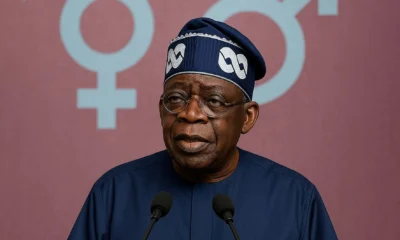
President Bola Tinubu has asked a United States court to stop the release of government records connected to past allegations of drug trafficking involving him.
The request concerns records held by the US Department of Justice, Federal Bureau of Investigation (FBI) and Drug Enforcement Administration (DEA).
American transparency activist Aaron Greenspan is seeking the documents through a Freedom of Information Act (FOIA) lawsuit against several US government agencies.
Greenspan has requested records linked to investigations involving Tinubu, including the FBI’s complete file on the Nigerian president and FBI Form 302 interview records from 1992 and 1993.
His lawsuit also covers an alleged record connected to a 1993 US civil forfeiture case involving about $460,000 associated with Tinubu.
Tinubu has consistently denied wrongdoing in connection with the allegations.
In court filings submitted on Friday, his lawyers, Christopher W. Carmichael, Victor P. Henderson and Oluwole O. Afolabi, argued that releasing the records could infringe on the president’s privacy rights.
The lawyers said the previous forfeiture proceedings did not disclose details of any potential criminal investigation involving Tinubu.
“Submitted in that proceeding, did not reveal the details of a possible criminal investigation (or its results) involving Intervenor,” they argued.
Tinubu’s legal team said Greenspan was seeking information that had not previously entered the public domain.
They maintained that the release of some information from a government file does not automatically remove an individual’s privacy interest in the remaining records.
“The purpose of Plaintiff’s motion is to obtain such information because it is not public,” the court document stated.
The lawyers cited previous decisions by the US Supreme Court to support their position that individuals can retain privacy interests in government investigative files even when portions of those files have already become public.
“While some information may appear in portions of public records, an individual still retains a privacy interest in the details that remain undisclosed,” they argued.
They further distinguished between being mentioned in a previous investigation and having the contents of investigative records released publicly.
“Regardless of the prior disclosure in the forfeiture proceeding, Intervenor retains a privacy interest in potential disclosure of the investigative files sought by Plaintiff,” the lawyers stated.
Tinubu’s lawyers also disputed Greenspan’s arguments concerning the FBI’s search for records, the DEA’s records index and other documents that US authorities withheld or redacted.
According to the legal team, Greenspan’s broader objective was to obtain government records containing Tinubu’s name.
They therefore urged the court to reject efforts to compel the release of documents that they argued US law protects from public disclosure.













BREAKING: INEC releases final list of Benue governorship candidates, retains Alia, Ode

You won’t even make bench — Mourinho warns Real Madrid players

BREAKING: Many injured as vehicles conveying Benue APC supporters involved in terrible accident in Lafia

Police arrest suspect over counterfeit naira production in Abia

Benue 2027: Dave Ogbole appointed Deputy DG of Shija/Edoh Campaign Council

2027: Benue NDC updates list of governorship campaign team [FULL LIST]

Big Smart dedicates AFRIMMA award to late father, Benue

‘I was told I’d be a minister, then my name disappeared’ — Lawani

Idoma man can’t govern Benue, Tiv not ready to hand over power – Steve Lawani

TRI TOWER: Another Idoma son, Lawrence Emmanuel of PromiseLand Estate unveils 22-storey luxury project in Abuja

NAF bombards kidnappers’ hideouts in Ogbadigbo
